

Edwin Link, American inventor and entrepreneur, conducted the first saturation dive as part of his Man-in-Sea project in 1962. Belgian diver Robert Stenuit became the first aquanaut and spent 24 hours and 15 minutes underwater in Link’s submersible decompression chamber (S.D.C.) at a depth of 200 feet (61 m) in the Mediterranean Sea. This initial saturation dive proved humans could breathe and survive under pressure for extended periods of time.
slideshow
Underwater Habitats
The mystery of the underwater world has captured the human imagination for millennia. For the vast majority of that time exploration was limited to how long one could hold their breadth—even for the best divers this was minutes at best. In the 1700s, diving bells extended the time able to be spent underwater, but the technology was tedious, cumbersome, and still limiting to the immediate area around the diving bell. Then submarines become mainstream in the late 1800s, and scuba gear in the 1940s. Exploration was becoming more accessible and everyday people were getting a glimpse of the beautiful world below. But one daunting question remained— “Can humans ever live underwater?”
For early inventors Edwin Link and Jacques Cousteau, it wasn’t a matter of if, it was a matter of when. 1962 became a banner year. First, Link tested his decompression chamber, a suspended barrel that allowed an aquanaut to remain underwater at 200 feet (61 m) for over 24 hours. Then Cousteau built the first underwater habitat, a small barrel sized container tethered to the seafloor. Aided by Cousteau’s media savvy, it made headlines across the world. The Diogenes, later known as Conshelf I, proved humans could live for an extended period of time underwater and it would inspire the creation of many habitats, some small or homemade and others the pillar of expensive research initiatives. Soon, it became clear—living underwater revealed an amazing world that science has only barely glimpsed.
Here, a photo slideshow reveals some of the more famous habitats, from the early days of habitat invention and innovation to today.


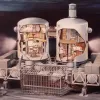


Submersible Decompression Chamber
Credit: The Link Collection
Conshelf I
Credit: WikipediaJacques Cousteau built the Conshelf I or Diogenes in 1962 to determine if humans could live underwater for an extended period of time. Two divers lived in the habitat at a depth of 33 feet (10 m) for a week off the coast of Marseille, France. While the divers studied the surrounding marine environment, doctors monitored their health from shore.

Conshelf II
Credit: Still from the film World Without SunIn 1963, Cousteau constructed the Conshelf II 33 feet (10 m) deep in the Red Sea off the coast of Sudan. Conshelf II included three separate units consisting of a domed submersible hanger that stored the Diving Saucer, a “starfish” shaped habitat that housed up to six divers, and a cylindrical deep-sea “cabin” that supported two divers at 100 feet (30 m). The Conshelf colony was featured in Cousteau’s film World Without Sun, which would inspire divers across the globe to pursue building their own habitat.

Conshelf III
Credit: WikipediaCousteau’s third Conshelf project successfully housed six divers at a depth of 328 feet (100 m) for three weeks off the coast of France, proving that humans could survive at extreme depths using a technique called saturation diving. This experiment was foundational to the construction of future deep-sea habitats like the US Navy’s Sealab habitats.

SPID
Credit: The Link CollectionEdwin Link designed the Submersible-Portable-Inflatable Dwelling (SPID) as part of his Man-in-Sea Project. The small habitat could support two divers and was first deployed in 1964. This was Link’s second major saturation diving experiment, following the use and creation of his submersible decompression chamber.

Sealab I
Credit: Courtesy The Man in the Sea MuseumThe US Navy began its foray into underwater habitats in 1964. The Sealab was established 192 feet (59 m) deep in an extinct volcano off the coast of Bermuda. The main objective of the habitat was to study the human body’s response to saturation diving over a long period of time. Four divers remained underwater for 11 days. The mission showed that diving for an extended period of time at depth was safe, while also revealing challenges to underwater living and use of helium in the breathing gas mixture. The helium atmosphere caused a “Donald Duck” effect where divers’ voices were high pitched due to sound traveling faster in helium. The helium also reduced the ability of wetsuits to warm the divers as they swam, since the black rubber foam became saturated with gas bubbles, and helium is a poor insulator when compared to air. The experiment also revealed that the underwater habitat was prone to high humidity. However, the overall success of the mission gave confidence to the diving community that human exploration of the deep sea was attainable.

Sealab II
Credit: US NavyThroughout 1965, the US Navy conducted experiments using the Sealab II, the successor to Sealab I. Three teams spent 15 days each underwater at a dept of 205 feet (62 m). Notably, the Navy used a trained porpoise named Tuffy to ferry supplies from the surface. Part of the Sealab II mission was to test wreckage repair and salvage underwater. The most complicated of their tasks was the installation of an underwater weather station.

Ichthyander
Credit: Still from the film Underwater House ‘Ichthyander 68’The Ikhtiandr habitat, also known as the Ichthyander Project, was built in 1966 by a group of diving enthusiasts in the city of Donetsk in the Soviet Union. Several of the divers were scientists working for the Institute of Mining Mechanics and Technical Cybernetics where they scavenged metal scraps to build the habitat. Two aquanauts stayed in the habitat for four days in the Crimean Black Sea before a storm required them to end the first trial use. Over the next three years, the engineers built new modules, including Ikhtiandr 67 and Ikhtiandr 68. Without the financial support of the government, the Ikhtiander project later disbanded.
Ikhtiandr was just one example of shallow water habitats built by diving enthusiasts during this time period. The Glaucous in England, the Hebros in Bulgaria, the Meduza in Poland, the Caribe off Cuba, and the Malter in Germany, were similar in this regard.

Sadko
Credit: Press Photo of Sadko-2In 1966, the Leningrad Hydrometeorological Institute lowered the Sadko habitat underwater near Sukhumi in the USSR. It was the first of three Sadko habitats. While the first habitat was lowered to 41 feet (12.5 m) the second and third habitats were placed at 82 feet (25 m) deep. The Sadko program’s primary goal was to study water movement and sound underwater.

Malter
Credit: Manfred Böner via the Berlin-Wendenschloß Sport Diving MuseumThe Malter was an underwater habitat built by recreational divers in the diving club of the Society for Sport and Technology in Dresden in Soviet-occupied East Germany. Inspired by the success of the Hebros, three intrepid divers decided to take on building their own habitat. In 1968, a year after the project’s kickoff, the habitat was lowered in a lake by the Malter Dam. The night before divers were to enter the habitat, a cold snap froze the water and divers Manfred Börner and Karl-Heinz Foltyn adjusted to make an ice dive. They stayed in the habitat for 48 hours. During the 16 years Malter was in use, over 500 divers stayed in the habitat and used it for research or training.

Edalhab
Credit: United States Department of Commerce and NOAAThe Edalhab I was engineered and built by University of New Hampshire students in the Engineering Design and Analysis Laboratory. At 8.5 feet (2.6 m) high and 11 feet (3.3 m) long, it was a relatively small habitat. Except for a $1,500 grant from the Navy, most of the parts were scavenged, retrofitted, or altered. On April 26, 1968, four students entered the habitat and remained underwater in Lake Winnipesaukee for 48 hours.
The University of New Hampshire and NOAA partnered in 1972 to conduct the Florida Aquanaut Research Expedition (FLARE) in four coral reef environments off the coast of Miami. Multiple scuba diver teams stayed in the Edalhab II for up to 5 days.

Tektite
Credit: NOAAThe success of the Navy’s Sealab II project prompted civilian departments of the U.S. government to consider use and study of underwater habitats and aquanauts. The Department of the Interior and NASA pooled resources to conduct an experiment on how an extended period of saturation diving affected human behavior and physiology. The first Tektite habitat housed four divers for 60 days off the coast of the U.S. Virgin Islands.

Sealab III
Credit: US NavySealab III intended to expand upon the Navy’s research started by the Sealab I and II habitats, however, the project ended abruptly during the testing phase when diver Berry Cannon died while fixing a leak. Though the Navy ended its underwater habitat, the Sealab project informed many of the future habitats built by other agencies, governments, and private endeavors.

Sprut
Credit: Cover of book by Alexander KorolevThe Sprut, aka Octopus, was designed by three Soviet divers from Moscow who conducted research for the All-Union Research Institute of Fisheries and Oceanology. It was a unique habitat that relied upon internal air pressure to maintain its shape. Rather than having a hard external shell, the exterior was a pliable rubber fabric that ballooned up from the seafloor where it was tethered with several spaced cables. The design was great for small projects due to its mobility and use without extensive support vessels.
The first Sprut design was homemade with a Singer sewing machine and plywood flooring. Though the first model failed upon resurfacing, a newspaper article sparked the interest of filmmakers, who then funded the construction of the next Sprut design. Subsequent models, including the Sprut M and Sprut U, improved upon the first design and were manufactured at the Zagorsk rubber plant. In total, 10 Sprut habitats were built from 1967 to 1991 when the Soviet Union collapsed.

BAH
Credit: WikipediaThe Biological Institute Helgoland (BAH) was a German habitat that was used for an 11-day mission in the North Sea in 1968. The life support system of the habitat relied upon a support vessel at the surface via a cable. Stormy weather during the initial mission caused difficulties due to the surface wave swell and it was determined an updated habitat with a better integrated life support system was required.

Chernomor
Credit: P.P. Shirshov Institute of Oceanology of the Russian Academy of SciencesThe Chernomor habitat was launched in the summer of 1968 by the USSR Academy of Sciences Institute of Oceanography in the Blue Bay on the Black Sea coast of the Caucasus near Novorossiysk. It was the world’s first undersea habitat built primarily for the study of marine science. Five teams of aquanauts called Chernomor home for a total of 100 days during 1968.

Helgoland
Credit: NURTECThe German-built Helgoland was deployed in 1969 as an upgrade to the first BAH habitat. While BAH required a support vessel, Helgoland used an unmanned surface buoy that was better equipped to handle the waves of the North Sea. The buoy contained a generator, compressed air, and filtered water that it supplied to the habitat below. The habitat was used in the North Sea, Baltic Sea, and on Jeffrey’s Ledge in the Gulf of Maine.

Seatopia
Credit: JAMSTECThe Seatopia system was built between 1969 and 1971 by the Japan Association of Underwater Exploration as part of an initiative to study diving technology. Upon its completion, ownership of the habitat was transferred to the newly formed Japan Science and Technology Center (JAMSTEC). The Seatopia project’s habitat used an 82 foot (25 m) long support buoy that sat above the habitat and a small pod that lowered the aquanauts from the buoy to the habitat like an elevator.
In 1972, four aquanauts spent 44 hours underwater and 30 minutes at a depth of 98 feet (30 m) offshore from Tago Port in Nishiizu Town, Kamo District, Shizuoka Prefecture. The following year another mission was completed but at a depth of 197 feet (60 m). During the two missions, scientists carefully monitored how saturation diving affected the physical and mental health of the aquanauts. The missions also helped improve saturation diving techniques and use of related equipment.

Aegir
Credit: NOAAThe Aegir, named after a sea giant of Norse mythology, was a habitat structure and laboratory designed to be located on the seafloor, which allowed scientists to live and work underwater for extended periods of time. The Aegir consisted of two large cylinders connected by a sphere in the center. Unlike Hydrolab, the Aegir had two ballast tanks which allowed it to raise and lower itself to the seafloor, rather than requiring use of a crane. The Aegir was deployed near St. Croix, U.S. Virgin Islands. Funding for the project eventually ran out and it was dismantled. A portion of the Aegir was permanently sunk as an artificial reef at Butler Bay, St. Croix, U.S. Virgin Islands, where divers are able to visit it to this day.

Tektite II
Credit: NOAAThe successful Tektite mission prompted construction of a second Tektite habitat. The Tektite II was home base for 10 Department of the Interior missions in the spring and summer of 1970. Each mission included four scientists and one engineer. Tektite II is most notable for the all female mission led by Sylvia Earle.

Hydrolab
Credit: NOAAThe Hydrolab was the National Oceanic and Atmospheric Administration’s first underwater habitat. Up to four aquanauts could live in the habitat for up to weeks at a time. During the length of its use from 1970 to 1985 over 700 scientists from over 180 missions stayed within the Hydrolab. Initially, the Hydrolab was positioned off the coast of the Bamahas. It was later moved to St. Croix, U.S. Virgin Islands in 1977. Upon decommissioning, it was donated to the Smithsonian Institution where it was on display at the National Museum of Natural History until 1999.

La Chalupa
Credit: NOAALa Chalupa was initially built as a research station by the Puerto Rico Inter-National Undersea Laboratory. After its completion in 1972, the habitat was the base of 12 scientific missions off the coast of Puerto Rico. In 1986, the habitat was moved to Key Largo and was transformed into the Jules Undersea Lodge, an underwater hotel consisting of two private rooms and a common area. The hotel is still in operation to this day.

Medusa
Credit: Marine Resources Development FoundationThe United States Naval Academy built the Midshipman Engineered & Designed Undersea Systems Apparatus (MEDUSA) in 1973 as part of a student engineering program. The Naval Academy donated the completed habitat to the Marine Resources Development Foundation where it was then submerged off of the Florida Keys to be used primarily as a teaching facility. In 1985, the habitat was renamed the MarineLab and moved to another lagoon off of Key Largo. The habitat remained in use until 2018.

Aquarius
Credit: NOAAThe Aquarius habitat is the only operational underwater laboratory in existence. Built in 1987 by NOAA, it was first deployed off the coast of the U.S. Virgin Islands in St. Croix's Salt River Canyon where its processor, the Hydrolab, once sat. Following a battering by Hurricane Hugo in 1990, the habitat was refurbished and moved to the Florida Keys National Marine Sanctuary. Ownership of the habitat was eventually passed on to the Florida International University in 2014 to ensure the habitat could remain a critical fixture for monitoring the surrounding coral habitat through scientific research.

Galathée
Credit: Copyright Créations Jacques RougerieThe first underwater habitat built by French visionary architect Jacques Rougerie was deployed in 1977. Unlike most underwater habitats that are permanently fixed on the seafloor, the Galathée is moored via a cable and could drift above the seafloor between 30 to 197 (9-60 m). It was a transportable habitat that could be deployed in as little as 30 minutes.

Hippocampe
Credit: Créations Jacques Rougerie via WikipediaThe Hippocampe was designed in a similar style to Galathée—it sat suspended in the water column. Launched in 1981, it was Jacques Rougerie’s second underwater habitat. Hippocampe accommodated two aquanauts for up to 15 days, and was designed to aid offshore industry and scientific research.