

Warm-Blooded Fish: How Competition Helped Some Fish Keep Their Heat

When thinking of warm-blooded animals, usually mammals or birds come to mind. What about the animals living in the sea? Most fish are cold-blooded, meaning they depend on the temperature of the surrounding waters that they live in to control their body heat. However, there is a unique group of fish that defy this norm—only about 40 species out of more than 36,000 can generate heat internally and keep parts of their body warmer than the water around them. In a new collaborative study, a team of scientists studied this group of fish to answer questions about their emergence in the ocean. These warm-blooded fish are called endotherms and understanding how and why they evolved this ability is an intriguing story of evolution and unexpected connections within our ocean.
What Is Fish Endothermy?
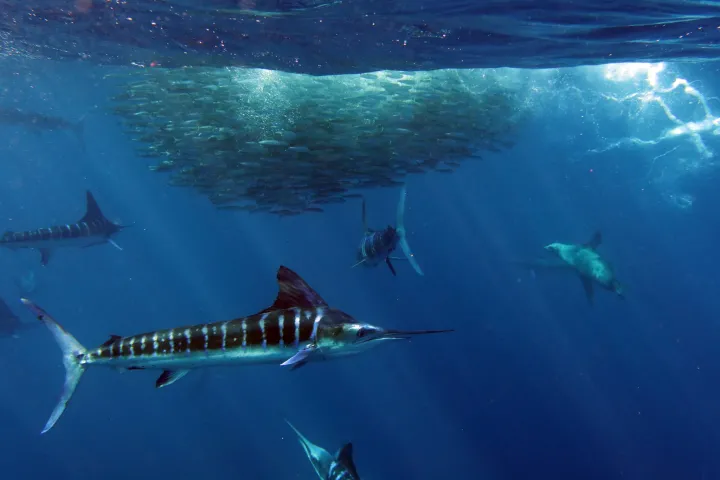
Endothermy means an animal can produce its own heat through normal cellular or metabolic processes and keep its body temperature stable. For warm-blooded fish, this means that they can generate heat in certain muscles or parts of their bodies. This ability aids them in swimming faster, hunting more actively, and surviving in colder waters. Some examples of fishes that possess this skill are tunas, marlins, and swordfish. These fish are known for their speed and powerful bodies and are often the apex predators of their food webs.
Endothermy is very common in mammals and birds, but extremely rare in fish. So why do only a few fish species have it, and how did it come about? Many theories over the years suggest these fish swam faster or deeper or adapted to cooling oceans millions of years ago. Testing these ideas proved to be tricky because past studies didn’t have the tools to explore more complex evolutionary patterns across various kinds of fish and could only look at a few species.
A Widespread Collaboration with Big Surprises
Recently, a team of more than 20 scientists from around the world, including the Scripps Institution of Oceanography and the Smithsonian’s National Museum of Natural History, collaborated to tackle this mystery. Using combined expertise in fish biology, genetics, mathematical modeling, and paleontology, this was a true team effort. At the center of this work was building the largest fish family tree to ever be created using molecular data. The researchers studied DNA from over 1,000 ray-finned fish species, representing all major groups and including every known warm-blooded fish family. This allowed the scientists to trace when fish endothermy evolved and to place it within fish evolutionary history.
What they found was quite interesting for discoveries in evolution, particularly for ocean creatures who have existed for thousands of years. Endothermy appeared independently at least four times in ray-finned fish groups that aren’t closely related. This means different fish species separately evolved the ability to keep warm, an example of convergent evolution. The big surprise, however, came when they looked beyond the fish themselves.
Whales and Warm-Blooded Fishes: An Unexpected Link
Many scientists believed that climate change during the Cenozoic period led to the rise of fish endothermy as a response to keep their bodies warm in the cooling oceans. But when this theory was tested using a newly developed mathematical model, strong evidence connecting the ocean temperature drops to the trait’s evolution was not found. Instead, the researchers noticed that the timing of fish developing endothermy closely matched the diversification of cetaceans, or whales, during the Eocene to Miocene periods, about 40 to 10 million years ago.
Dr. Melendez-Vazquez, lead author on the paper, says that one of the most exciting parts of this study was how the link to whale evolution emerged unexpectedly while exploring fish genetics. “Overall, the whales are a happy accident. We didn’t start off with that mentality; it just appeared in the process of the research. That highlights how dynamic science is. You can head out with a destination in mind and along the way you can explore them [accidents] or ignore them [accidents]”.
What exactly does this finding mean? Whales evolved from land mammals that invaded the oceans millions of years ago. As they became successful marine predators and large players in ocean ecosystems, cetaceans may have added new competitive pressure on fish that shared similar food sources and habitats. Many warm-blooded fishlike tunas and billfish feed on the same kinds of prey that whales hunt, such as small fish, squids, and plankton.

The study suggests an evolutionary competition where fish enhanced their swimming abilities and metabolism by evolving endothermy to better compete with whales for food and space. The change wasn’t just about fish trying to be faster hunters but about staying active longer and swimming more efficiently in a changing ocean landscape that was dominated by other warm-blooded marine animals. This competition may have driven the evolution of warm-bloodedness in fish despite its high energy costs.
Digging Into the Genes
To explore how fish evolved this ability at the molecular level, the team analyzed genomes from 205 marine species, including warm-blooded fishes, whales, penguins, and sharks. They looked for genes that showed signs of natural selection related to heat production, muscle function, and metabolism.
Scientists found that many warm-blooded animals share similar genetic changes that help them produce and maintain heat. While some of these genetic adaptations are common across different species, others are unique and tailored to how each animal produces warmth. For example, whether they keep only certain parts of their body warm like the eyes and brain, or their entire selves.
This tells us that evolution found different genetic “solutions” to the challenge of warming fish bodies, tailored to each fish’s ecology and physiology. It also shows how complex traits like body heat regulation rely on many genetic factors working together.
Why So Few Fishes Are Warm-Blooded
If endothermy offers such advantages, why didn’t more fish evolve it? The answer comes down to energy costs and necessity. Keeping the body warmer than the cold ocean water requires a lot of energy. Only fish that “need” this added metabolic power, like those that compete against marine mammals for similar prey, could afford it. The stakes are high in the game of ocean survival.
Some fish may have the physical traits or genes that could support endothermy but never make the evolutionary jump because they don’t face the same pressures or because the benefit would not outweigh the energy cost. For many fish, cold-bloodedness is enough to survive and much less costly in the role that they each play within their specific ecosystem.

Why Does This Matter?
Understanding fish endothermy is more than just answering scientific questions about warm-blooded fish. “This helps us open our eyes to how dynamic the ocean is, how everything is connected, says Dr. Melendez-Vazquez . “The ocean itself is a melting pot of organisms—they’re all connected. This helps us understand how evolution occurs in our oceans. We are guessing something that happened millions and millions of years ago. It’s very speculative in that sense”. This study reveals how deeply interconnected life in the ocean is. Evolutionary changes in one group of animals can ripple through ecosystems, pushing others to adapt in surprising ways.
It also offers insight into how species may respond to today’s rapid ocean changes caused by a warming climate and human development. As ocean temperatures shift and species move to new areas, new competitions will emerge. Some fish may find themselves facing new neighbors or predators with varying metabolic strategies. Knowing how fish evolved endothermy in the past may help scientists predict which animals might thrive or struggle in the future ocean.
A Story of Discovery and Collaboration
With scientists from Japan to Oklahoma, France to Washington, D.C., this work is a great example of how modern science is often a global and collaborative effort. It also reminds us that scientific discovery isn’t a straight path. Sometimes you set out to answer one question and find new and unexpected answers. It’s this journey that can lead to the real breakthroughs.