Acidification

LATEST TODAY'S CATCH

Ocean Acidification with Dr  Francisco Chavez

Ocean Acidification with Dr. Francisco Chavez

Apr 30, 2013 - 9:29AMDr. Francisco Chavez of the Monterey Bay Aquarium Research Institute estimates that a million tons of CO2 enter the ocean hourly. His studies in Peru explore the phenomenon of ocean acidification, which occurs when waters have...
Apr 5, 2011 - 4:18PM
Much of the carbon dioxide we emit into the atmosphere ends up in the ocean...
Feb 14, 2011 - 4:13PM
Scientists predict that ocean acidification will impact communities around...

SPOTLIGHT

Searching for the Ocean Acidification Signal

It’s not an easy question to answer. In the lab, scientists can set up a series of seawater tanks with a variety of pH...
Jul 31 2012 - 4:52pm
For three weeks, the MV Chertan is home-base for the scientific team and will be transformed in a floating laboratory to study volcanic CO2 seeps.
Very close to the seeps pH is lowest and water is most acidic. Corals cannot grow in these conditions - only seaweed can.
Aug 2 2012 - 3:34pm
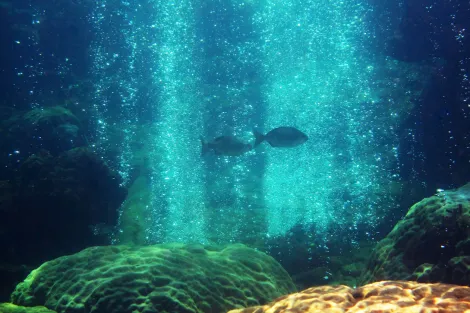
Nestled among the beautiful coral reefs of Papua New Guinea (PNG) is a place that could provide the key to our understanding of one of the biggest threats to coral reef survival: Ocean Acidification. Here cool carbon dioxide naturally bubbles out of volcanic cracks in the shallow sea floor and...
Mar 20 2013 - 11:52am
Boring sponges get a bad rap. Their own name betrays them, announcing to the world that they are unexciting, ordinary and quite frankly, boring. However, if ever a misnomer existed, this is it.
Aug 2 2012 - 3:11pm
Branching corals, because of their more fragile structure, struggle to live in acidified waters that surround the volcanic CO2 seeps of Papua New Guinea. Read more about how reef scientist Laetitia Plaisance uses carbon dioxide seepsocean acidification and how it will affect biodiversity on coral...
A healthy coral reef in Indonesia
Dec 15 2009 - 12:19pm
Coral reefs are beautiful, vibrant ecosystems that house roughly one quarter of all marine species and provide billions of dollars in products and services to humans each year. But they are also vulnerable to human activities – both direct disturbances and small, indirect effects that build up over...
Jul 31 2012 - 4:17pm
Intense volcanic CO2 vents in Ili Ili Bua Bua, Normanby Island, Papua New Guinea where CO2 bubbles out of the reef making water acidic as we would expect to see in the future due to the burning of fossil fuels. The town's name, Ili Ili Bua Bua, means "Water Water Bubble Bubble" in the local dialect...
Jul 9 2010 - 3:22pm
Fossil fuels that power our cars, homes, and businesses add carbon dioxide (CO2) to the atmosphere. The ocean absorbs large portions of this CO2 and acts as a buffer against climate change. But, Dr. Francisco Chavez of Monterey Bay Research Institute points out that as the ocean absorbs more CO2,...
Apr 5 2011 - 4:18pm
Much of the carbon dioxide we emit into the atmosphere ends up in the ocean. As CO2 levels rise, seawater becomes more acidic. This change in chemistry poses a serious threat to marine organisms including snails, corals, such as in the above photo showing a single bleached polyp, and fish.
Ocean Acidification in the Puget Sound
Feb 14 2011 - 4:13pm
Scientists predict that ocean acidification will impact communities around the world. One of them is the Suquamish Nation, an American Indian tribe on the Puget Sound, in the Pacific Northwest. Students from the Suquamish Tribal Early College High School produced this video to raise awareness about...
Aug 2 2012 - 4:37pm
Scientists don’t often get the opportunity to travel through time. But nestled among the beautiful coral reefs of Papua New Guinea (PNG) is a place that provides a glimpse today of what could be the biggest future threat to coral reef survival: Ocean Acidification.
Jul 31 2012 - 5:53pm
The acidic waters from CO2 seeps can dissolve shells and also make it harder for shells to grow in the first place. Read more about how reef scientist Laetitia Plaisance uses carbon dioxide seeps to study ocean acidification and how it will affect biodiversity on coral reefs in the...
Coral Forests of the Deep Ocean
Jan 14 2011 - 12:27pm
Corals are not only found in shallow tropical waters, but in cold, dark, deep areas of the sea. Amazing coral forests are found at depths of 60-3,050 meters (200-10,00 feet). They support an abundance of marine life but are in peril from threats such as ocean acidification and bottom trawl fishing...
Dec 12 2012 - 1:00pm
It’s not an easy question to answer. In the lab, scientists can set up a series of seawater tanks with a variety of pH levels to figure out how different species react to more acidic water, observing the structure of their shells, their metabolism, or their behavior. Or researchers can go to areas...
World Oceans Day 2012 - Live Webcast
May 24 2012 - 3:55pm
On World Oceans Day - June 8th, 2012 - the Living Oceans Foundation hosted a live web-based conversation between Sylvia Earle at the Smithsonian's National Museum of Natural History and a team of scientists researching coral reefs and their communities around the Galapogos Islands.
Ocean Acidification with Dr  Francisco Chavez
Apr 30 2013 - 9:29am
Dr. Francisco Chavez of the Monterey Bay Aquarium Research Institute estimates that a million tons of CO2 enter the ocean hourly. His studies in Peru explore the phenomenon of ocean acidification, which occurs when waters have high concentrations of CO2.
Aug 2 2012 - 3:20pm
Closest to the seeps, where the pH is lowest and the water is most acidic, corals no longer grow. Instead there are sand, rubble and seagrasses that are able to survive.