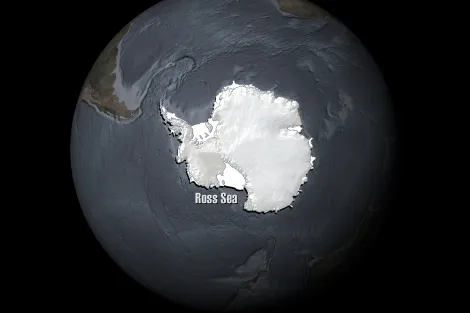
Despite the names "Atlantic" and "Pacific," the ocean is one giant interconnected ecosystem. Learn about the systems that hold it together, from sea ice and volcanoes to currents and chemistry.

LATEST BLOG POSTS

What We DON'T Know About the Deep Sea

Jul 13, 2012 - 1:01PMImagine: You’re in a small submersible, and you gently settle on the soft muddy bottom at a depth of 12,000 feet. It’s absolutely dark. What will you see when the exterior lights are turned on? Will you discover underwater...
Mar 8, 2012 - 11:22AM
Monodontids, the group of whales that includes the belugas and narwhals...
Sep 8, 2011 - 4:04PM
At a recent staff meeting a Smithsonian colleague mentioned that one of his...

SPOTLIGHT

Hydrothermal Vent Creatures

Travel to a world of perpetual night--the deep ocean hydrothermal vents near the Galapagos Rift where life thrives around...
Hydrothermal Vent Creatures
MORE PLANET OCEAN

AUDIO / VIDEO

  • Sea Ice in its Ever-Changing Forms

  • The earth's climate is changing – and it's causing sea levels to change too. Even small changes in sea levels can dramatically alter coastal landscapes all across the world.

    Sea Levels on the Move

  • <p>Climb aboard the scientific ocean drilling vessel <em>Chikyu</em> for a tour of this state-of-the-art research ship.</p>

    Tour the Chikyu

  • <p>Tube worms, crabs, shrimp, and other life forms thrive in the deep-sea ecosystem of hydrothermal vents.</p>

    Hydrothermal Vent Creatures

  • <p>On <strong><a href="http://earthquake.usgs.gov/earthquakes/eqinthenews/2011/se082311a/#summary">August 23, 2011 a 5.8 earthquake</a></strong> emanated from the little-known Central Virginia Seismic Zone. The epicenter was near Mineral, VA, but the tremor shook homes, schools, and office buildings in Washington, DC and beyond. In this brief video, Smithsonian educator Catherine Sutera uses a Slinky® to demonstrate two types of seismic waves that people in the area may have felt: the <strong><a href="http://earthquake.usgs.gov/learn/glossary/?term=P%20wave">P wave</a></strong>&nbsp;and the <strong><a href="http://earthquake.usgs.gov/learn/glossary/?term=S%20wave">S wave</a></strong>. Both are known as "body waves," because they move through the planet's interior. The P wave, also called the primary wave, is the fastest seismic wave. But it's the S wave that creates much of the above-ground shaking during an earthquake.    You can learn about body waves and the more complicated surface waves on <strong><a href="http://www.edcenter.sdsu.edu/ssc/3d/ssc3dproject.html">Michigan Tech's Geological and Mining Engineering and Sciences website</a></strong>. Want more specifics on the Virginia earthquake? Smithsonian geologist Elizabeth Cottrell answers the main questions on&nbsp;<em><strong><a href="http://www.smithsonianmag.com/science-nature/Q-and-A-Smithsonians-Elizabeth-Cottrell-on-the-Virginia-Earthquake.html">Smithsonian Magazine's</a></strong></em> website.&nbsp;</p>

    Demonstrating an Earthquake's Seismic Waves

  • <p>Dr. Isaac Ginis' presentation, "Eye on the Storm: Predicting a Hurricane's Path of Destruction."You can also read his "<strong><a href="http://ocean.si.edu/blog/ingredients-hurricane">Ingredients of a Hurricane</a></strong>" post on our blog.&nbsp;</p>

    Changing Tides Lecture: Predicting a Hurricane's Path of Destruction

  • <p>Learning about underwater vents, hot springs and the ecosystems that surround them</p>

    Submarine Volcanoes and Hydrothermal Vents

  • <p>Dr. Jan Backman studies geological samples that are rich in data to reveal clues to events that had an effect on climate change.</p>

    Dr. Jan Backman, Marine Geologist

  • Scientists from Woods Hole Oceanographic Institution and Rutgers University have researched the connection between the physical processes of the ocean and the life that lives there using a REMUS autonomous underwater vehicle.

    Exploring Ocean Life with an Underwater Vehicle

  • <p>This video explains some of the potential effects on the marine environment from the Deepwater Horizon oil spill.</p>

    The Gulf Oil Spill: Effects on Marine Life

  • See an animation showing over time, the receding of summer sea ice in the Arctic.

    Receding Ice Cover

  • <p>Dr Francisco Chavez studies the effect of CO2 on our oceans.</p>

    Ocean Acidification with Dr. Francisco Chavez

  • <p>How should you prepare for a hurricane? To help answer that, students from Bay High School in Bay St. Louis, Mississippi created this instructional video as part of the&nbsp;<strong><a href="http://ocean.si.edu/ocean-news/teens-focus-ocean-climate-issues-national-summit">Third Student Summit on the Ocean &amp; Coasts</a></strong>.</p>

    How Do You Prepare for a Hurricane? Students Tell Us How

  • The Woods Hole Oceanographic Institution's "Line W" program is conducting research at specific points in the North Atlantic Ocean to better understand how the oceans and the atmosphere work together to cause, and are affected by, climate variability on the earth.

    Line W: A 10-Year Portrait of Our Planet

IMAGE GALLERIES

  • Exploring the Ocean with Robots and Submarines

  • Robotic Glider Evades Fishing Nets

    Robotic Ocean Explorer

  • an orange sea star clinging to rocks in the ocean, documented by Census of Marine Life scientists

    Census of Marine Life: Wild and Wonderful Creatures

  • Seamounts, A Deep-Sea Habitat

PHOTOS

  • Hurricane Sandy "Frankenstorm" Over Cuba

  • Earth as seen from a satellite

  • Map of New England Seamount Chain

  • Deep Sea Drilling Vessel Chikyu

  • Measuring Ice Core Temperatures

  • Studying Hydrothermal Vent Life

  • Balanus Seamount

  • NOAA's Adopt a Drifter Program

  • Star Sand Grains Collected from Southern Japan

  • Saving Venice, Italy

  • Sea lion with data collector on back

  • Ocean “Pingos”

  • Alvin, Gulf of Alaska Seamount Expedition

  • Tracking Ocean Acidification