The Ocean Through Time

Life began in the ocean around 3.5 billion years ago and as evolution progressed, many species went extinct -- and some left behind fossils -- as others appeared. And even now, the ocean hasn't stopped changing as evolution continues and humans leave their mark.

LATEST TODAY'S CATCH

Elevator Rudists

May 1, 2013 - 9:48AMThese "elevator" rudists, an ancient bivalve, used one long heavy valve to anchor themselves in the sediment. They used their tentacles (shown here in pink) to filter food from the sea water. Discover more about the ancient...
Mar 21, 2013 - 9:20AM
This well-preserved fossil is the only intact partial skull ever found of a...
Feb 26, 2013 - 10:35AM
Two fossilized teeth from a megalodon (Carcharodon megalodon) dating back...
Aug 9 2012 - 10:27am
Where ocean currents were strong, ancient rudist “recliners” lay unattached on the seabed. Notice the pink tentacles, which were used to filter feed. Learn more about ocean life throughout deep time in our Ocean Over Time interactive or an image gallery. 
Jun 22 2011 - 5:44pm
Paeleobiologist Dr. Nicholas Pyenson, Curator of Fossil Marine Mammals for the Smithsonian's National Museum of Natural History (NMNH), set out with Jorge Velez-Juarbe, NMNH Research Student and Ph. D. Candidate at Howard University and Aaron O'Dea from the Smithsonian Tropical Research Institute...
Dec 4 2009 - 3:25pm
About 100 million years ago, during the heyday of the dinosaurs, reefs were built by mollusks called rudist clams. They looked very different from today's coral reefs.
Sep 21 2011 - 9:53am
This rendering shows life at the end of the Cretaceous Period, before the impact of a 6.2 mi (10 km) asteroid triggered mass extinctions on land and sea. Dinosaurs are the most famous victims of the extinction at the end of the Cretaceous, 65 million years ago. But they weren't alone. Nearly half...
Aug 15 2012 - 9:45am
The fossil tooth whorl of the ancient shark Helicoprion, dating back 290 million years before present. For a long time, people didn't know what the shark looked like—but, thanks to a CT scan of a fossil, researchers finally put the pieces together in 2013. Read more about this story in our ...
Sep 12 2011 - 1:10pm
CREDIT: Smithsonian Arctic Studies Center Basque Whalers Background Having already learned to hunt large whales in the Bay of Biscay in the 13th through 15th centuries, Basques began arriving in the rich whaling grounds of southern Labrador, Newfoundland, and the Gulf of St. Lawrence...
May 11 2012 - 11:46am
Nick Pyenson, curator of fossil marine mammals at the Smithsonian's National Museum of Natural History, holds an arm bone from a "toothed" mysticete from Vancouver Island. This is the second specimen found at this locality on the remote western side of Vancouver Island. Nick used a rock saw to...
Sep 12 2011 - 4:40pm
The evolution of whales represents one of the great stories in macroevolution. It's a narrative that has mostly benefitted from an extraordinary series of fossils recovered from rocks around the world, including challenging field areas in Egypt, Pakistan, and India. 
A photo of the cliffs at Mistaken Point, in Newfoundland
Oct 27 2011 - 3:37pm
When the cod fishery collapsed in Newfoundland in the early 1990s, the hopes of the local fish harvesters collapsed with it. Hundreds of Newfoundlanders moved away and businesses that depended on the cod fishery closed. But retired schoolteacher Kit Ward of Portugal Cove South wasn’t content to...
Jan 26 2012 - 11:26am
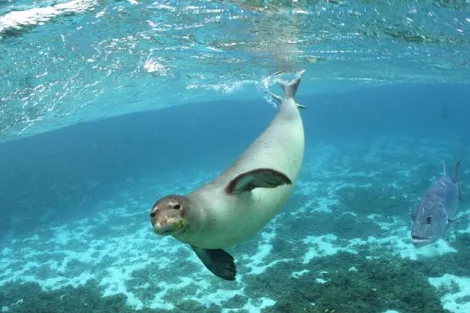
Sirenians, or seacows, are a group of marine mammals that include manatees and dugongs. In the modern ocean, only one species of seacow is found in each world region, however, the fossil record tells a different story. According to the fossil record of these marine mammals, which dates back 50...
Jan 26 2010 - 11:45am
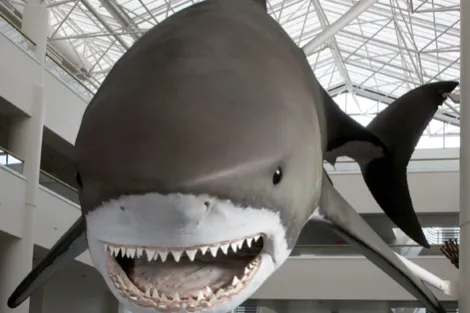
A life-sized model suspended over visitors at the San Diego Natural History Museum shows what an ancient shark, the Giant Megatooth (Carcharodon megalodon), might have looked like. More about the great white shark can be found in our Great White Shark featured story
Jan 26 2010 - 11:45am
Vertebrates evolved in the sea and eventually moved onto land. The ancestors of whales later returned to the sea, taking advantage of its rich food supplies. As early whales adapted to their new marine surroundings, a diversity of species evolved. Explore the the interactive "Did Whale Evolution Go...
Sep 20 2011 - 4:36pm
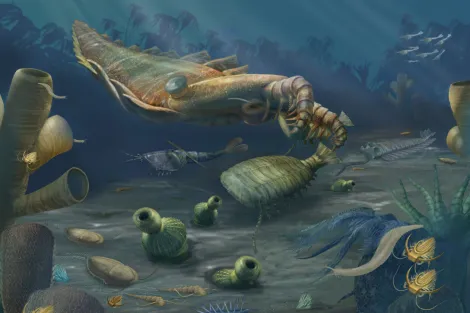
Crinoids (echinoderms related to sea stars and sea urchins) dominate the Paleozoic shallow water habitat in this illustration. They evolved a variety of stalk heights, which enabled them to capture food at different levels above the sea floor. The base of their stalks was modified to anchor the...
Sep 20 2011 - 3:42pm
Earth’s first animals had soft bodies. This illustration shows a community of soft-bodied Ediacaran (edi-A-karan) animals. Some species resemble living ocean creatures. Others are unlike any known organisms and cannot be classified. Scientists have found fossils of these fauna in sedimentary rocks...
Video of the Palauan primitive cave eel  Protanguilla palau
Aug 16 2011 - 2:31pm
A video of the Palauan primitive cave eel (Protanguilla palau) swimming in the Pacific off the Republic of Palau. Jiro Sakaue, a Japanese research diver, first discovered the new genus and species in a Palauan reef cave in 2009.
Feb 26 2013 - 10:35am
Two fossilized teeth from a megalodon (Carcharodon megalodon) dating back more than 20 million years.