Vents & Volcanoes

LATEST TODAY'S CATCH

Tubeworms on a Hydrothermal Vent (Riftia)

Dec 6, 2012 - 11:52AMRiftia tubeworm (Riftia pachyptila) colonies grow where hot, mineral-laden water flows out of the seafloor in undersea hot springs—such as the Guymas Basin of the Gulf of California at 2,000 meters (6562 feet), where MBARI took...
Jun 14, 2010 - 4:31PM
In this episode of the Podcast of Life, host Ari Daniel Shapiro dives deep...
Jan 26, 2010 - 11:45AM
The yeti crab (Kiwa hirsuta), an unusual, hairy crab with no eyes, was...

SPOTLIGHT

Submarine Volcanoes Erupting

Did you know that 80 percent of the volcanic eruptions on Earth take place underwater? These underwater eruptions occur...
Submarine Volcanoes Erupting
Tube worms called riftia occupy a deep-sea vent
Jun 14 2010 - 4:31pm
In this episode of the Podcast of Life, host Ari Daniel Shapiro dives deep to discover a white worm as tall as your refrigerator that breathes through bright red feathery "lips." This isn’t a creature from outer space. Meet Riftia, a tube worm that lives in deep-sea vents, and learn the surprising...
Aug 27 2012 - 2:23pm
Orange shaded areas are major drainage basins of Belize, Guatemala, and Honduras that contribute sediment to the Caribbean. Wind and current patterns are represented by red and black arrows, respectively. Following the Río Motagua on land and cycling through the Gulf of Honduras is one plausible...
Jan 26 2010 - 11:45am
NOAA’s New Millennium Observatory (NeMO) was set up to study geologic, chemical, and biologic interactions along the mid-ocean ridge system. Learn more about NeMO and watch a video about underwater volcanoes.
Jan 26 2010 - 11:45am
The yeti crab (Kiwa hirsuta), an unusual, hairy crab with no eyes, was discovered in 2005 on a hydrothermal vent near Easter Island. It represents not only a new species but also a new genus—Kiwa, after the mythological Polynesian goddess of shellfish. Learn more about the Census of Marine Life and...
Hydrothermal Vent Creatures
Dec 3 2010 - 1:59pm
Travel to a world of perpetual night--the deep ocean hydrothermal vents near the Galapagos Rift where life thrives around superheated water spewing from deep inside the Earth. Discovered only in 1977, hydrothermal vents are home to dozens of previously unknown species.
Aug 24 2012 - 3:57pm
Aug 27 2012 - 12:14pm
But what path, precisely, did this pumice take to reach Belize from the Guatemalan Highlands? Maps of drainage networks that reach the Gulf of Honduras and currents in the western Caribbean Sea are important for describing how the pumice could have been transported. The Río Motagua and Río Dulce...
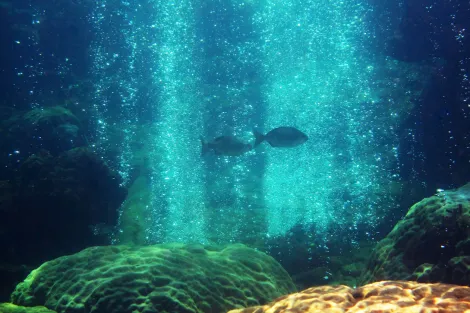
Very close to the seeps pH is lowest and water is most acidic. Corals cannot grow in these conditions - only seaweed can.
Aug 2 2012 - 3:34pm
Nestled among the beautiful coral reefs of Papua New Guinea (PNG) is a place that could provide the key to our understanding of one of the biggest threats to coral reef survival: Ocean Acidification. Here cool carbon dioxide naturally bubbles out of volcanic cracks in the shallow sea floor and...
Aug 2 2012 - 4:37pm
Scientists don’t often get the opportunity to travel through time. But nestled among the beautiful coral reefs of Papua New Guinea (PNG) is a place that provides a glimpse today of what could be the biggest future threat to coral reef survival: Ocean Acidification.
Aug 27 2012 - 11:04am
This map shows volcanoes of Central America and within the Caribbean Sea. The red triangles represent volcanoes known to have erupted in recent time (within the last 10,000 years) and white stars are pumice discovery sites. Learn about how Smithsonian scientists tracked pumice from land back to the...
Jul 13 2012 - 1:01pm
Imagine: You’re in a small submersible, and you gently settle on the soft muddy bottom at a depth of 12,000 feet. It’s absolutely dark. What will you see when the exterior lights are turned on? Will you discover underwater volcanoes and hydrothermal vents, as some astonished geologists did back in...
Submarine Volcanoes Erupting
Jan 14 2011 - 1:41pm
Did you know that 80 percent of the volcanic eruptions on Earth take place underwater? These underwater eruptions occur regularly, forming new landmasses and providing a living environment for deep-sea creatures. In 2009, scientists discovered the deepest ocean eruption ever found—the West Mata...
Jan 26 2010 - 11:45am
Flower-like zoanthids, relatives of coral, carpet a hydrothermal vent. This species of zoanthid is the first ever discovered at a hydrothermal vent. See more pictures of incredible deep sea diversity at our slideshow!
Jan 26 2010 - 11:45am
Census researchers manipulate the robotic arm of the remotely operated vehicle (ROV) Quest to study shrimp and other deep sea life forms. They discovered the creatures at a hydrothermal vent 3 kilometers (1.9 miles) below the surface of the Atlantic.
Submarine Volcanoes and Hydrothermal Vents
Jan 14 2011 - 1:41pm
Recent scientific discoveries have revealed an underwater community of marine animals and other organisms that thrive in the dark depths of the ocean near hydrothermal vents and undersea volcanoes. This ocean ecosystem is dependent on the presence of hydrothermal vents, which release hot and...
Dec 6 2012 - 11:52am
Riftia tubeworm (Riftia pachyptila) colonies grow where hot, mineral-laden water flows out of the seafloor in undersea hot springs—such as the Guymas Basin of the Gulf of California at 2,000 meters (6562 feet), where MBARI took this photo. As volcanic activity deep below the seafloor changes,...