

World Fisheries from Sea to Table
Worldwide, fisheries touch our lives in countless ways. If well maintained, they can feed millions of people, generate jobs and income, help maintain long-standing community and cultural traditions, and provide a range of products from medicines to clothing. World Fisheries Day, observed annually on November 21st, is an opportunity to reflect on the importance of fisheries around the world and what we—as fishers or consumers—can do to ensure that they stay healthy and productive. Learn more in our Sustainable Seafood section.



Pike Place Fish Market
Credit: Joey Brookhart/Marine Photobank
Fleet of Fishing Boats
Credit: Mike Markovina/Marine PhotobankBoats of an artisanal fishing fleet, packed together in a typical Moroccan port.

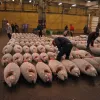
Tuna at Tsukiji Fish Market
Credit: Fisherman via Wikimedia Commons
Buyers examine tuna lining the floor of Tsukiji Fish Market in Tokyo, Japan. Ounce per ounce, tuna is one of the most valuable varieties of seafood. In 2012, a single 593lb bluefin tuna sold for $736,000 in a Japanese market. Not surprisingly, populations of bluefin tunas have declined to very low levels, and the species is listed as endangered.

Unloading the Day’s Catch
Credit: Linda Schonknecht/Marine Photobank
Fresh Shellfish for Sale
Credit: Kathleen Reaugh/Marine Photobank
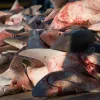
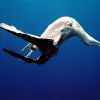
Finned Sharks in South Africa
Credit: Fiona Ayerst/Marine PhotobankMillions of sharks are caught each year for their dorsal fins, which are prized for shark fin soup. Top predators like sharks are important to maintaining biodiversity, and their removal can have ripple effects through an ecosystem. Learn more in our featured story about Sustainable Seafood and see how scientists use genetics to catch shark poachers.

Accidental Catch
Credit: Projeto Tamar Brazil/Marine PhotobankA fishing line with bait on the hook intended for tuna and other big fish is also a tasty snack for other animals such as this albatross, which drowned after being accidentally caught on a longline near Brazil. And it's a big problem. A 2003 study found that 300,000 birds are being killed each year by fisheries as bycatch, of which 100,000 are albatrosses. Fishermen are working with scientists to design new kinds of fishing lines that are less likely to catch albatrosses, or set their lines at night when the birds are less active.

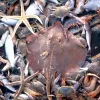
Bycatch in Shrimp Net
Credit: Eliott Norse/Marine Conservation Biology InstituteA skate is among the many bycatch species caught in this shrimp trawl net. More about sustainable seafood can be found in our sustainable seafood featured story.

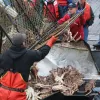
King Crab Fishing in Alaska
Credit: Valerie Craig/Marine Photobank
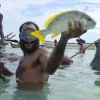
Celebratory Harvest in Papua New Guinea
Credit: ARC Centre of Excellence for Coral Reef Studies/Marine Photobank
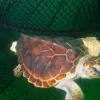
Loggerhead Escapes from Fishing Net
Credit: NOAAOne of the biggest threats to sea turtles, such as the loggerhead turtle (Caretta caretta) pictured here, is being accidentally caught and killed in fishing nets. Trapped in a net, the turtles are dragged through the water with no access to the surface to breathe, causing them to drown.
To address this problem, NOAA Fisheries worked with the shrimp trawling industry to install escape hatches into their nets called Turtle Excluder Devices, or TEDs. A crosshatch of bars in the middle of the net create a grid large enough for small shrimp to pass through, but not turtles and other large animals. When they hit the grid, they can then swim out through a hole in the net and escape.
Before TEDs were installed, an estimated 70 to 80 percent of turtle strandings on beaches were caused by shrimp nets. But since they were installed by U.S. shrimpers in the Gulf of Mexico in the late 1980s, strandings caused by shrimp nets are estimated to be down by at least 44 percent.