


The Deep Sea
Introduction
Below the ocean’s surface is a mysterious world that accounts for over 95 percent of Earth’s living space—it could hide 20 Washington Monuments stacked on top of each other. But the deep sea remains largely unexplored. As you dive down through this vast living space you notice that light starts fading rapidly. By 650 feet (200 m) all the light is gone to our eyes and the temperature has dropped dramatically. Dive deeper and the weight of the water above continues to accumulate to a massive crushing force. Any light still filtering down has diminished to appear completely black, leaving only animals and bacteria to produce the light found here. By 13,000 feet (4,000 meters), the temperature hovers just below the temperature of your refridgerator. At this depth, we’ve reached the average depth of the deep-sea floor, a place that may start to get a little muddy. The further we dive down from the surface, the less new food is available, making the fight to survive that much more challenging. Despite these harsh conditions, there is life—an astounding variety of creatures that will boggle your mind. You can’t dive to the deep ocean on your own, of course, but scientists have a variety of sophisticated technologies to explore this vast frontier.
Are You An Educator?
Open Ocean Zones
Oceanographers divide the majority of the ocean midwater into five broad zones. The very deepest depth of the ocean is roughly 2,000 meters deeper than Mount Everest is tall—36,070 feet deep (10,994 m)! Each zone has a different mix of species adapted to its specific light level, pressure, temperature, and community. About three-fourths of the area covered by ocean is deep, permanently dark, and cold. This is the deep sea.

Most are familiar with the surface layer, which extends down 650 feet (200 m) and receives the most sunlight, allowing photosynthetic organisms like phytoplankton to convert sunlight to energy. It is the home of pods of dolphins, schools of fish, and shoals of sharks. Scientists refer to this highly productive area as the epipelagic zone.
But the majority of the space in the ocean is a dark world. Dive below the epipelagic and you will enter the mesopelagic zone. Also known as the twilight zone, this area receives only faint, filtered sunlight, allowing no photosynthetic organisms to survive. Many animals have adapted to the near-darkness with large eyes and counterillumination.

Beginning with the bathypelagic zone, the ocean is completely void of light from the sun, moon and stars. Animals create their own bioluminescent light and, if they haven’t lost them, have highly light-sensitive eyes to see the light produced by other animals. The water temperature is near freezing. Travel deeper and you will find the abyssopelagic zone—the abyss. And finally, the deepest reaches of the ocean are found at the bottom of precipitous trenches. These locations venture into the hadalpelagic zone, places so deep only a handful of humans have ever traveled there so far.
Mesopelagic
The area of the ocean between 650 and 3,300 feet (200-1,000 m) is called the mesopelagic. Barely any light filters down to these depths, and yet still life thrives here. Squid, krill, jellies, and fish are super abundant in this zone. About 90 percent of the world’s fish (by weight) live in the mesopelagic—about 10 billion tons of fish. The bristlemouth fish alone may number at about a quadrillion, making them the most numerous family of vertebrates (animals with a backbone) in the world.

Bathypelagic
The bathypelagic is between 3,300 and 13,100 feet (1,000 and 4,000 m) beneath the ocean surface. It is an area void of light (called aphotic) and at 39 degrees Fahrenheit (4 degrees Celsius), it is very cold. Moreover, the pressure is over 110 times that at sea level. Creatures in this zone must live with minimal food, so many have slow metabolisms. Many rely on marine snow as their main food source. They are also characterized by squishy bodies and slimy skin. The black hagfish, viperfish, anglerfish, and sleeper shark are common fish that call this zone home. While something like the gulper eel, with its massive expandable gullet, is a rare and amazing sight and could almost be mistaken for an alien. Vampire squid and dumbo octopus also venture to these depths.

Abyssopelagic
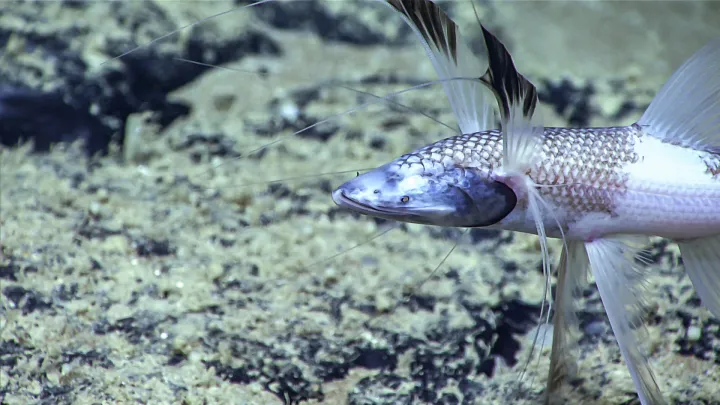
The Abyssopelagic extends from 13,100 to 19,700 feet (4,000-6,000 m) down to the seafloor or abyssal plain. Animals that can withstand the pressures in this depth, which can reach up to 600 times what is experienced at sea level are highly specialized. Tripod fish are an oddity that can be found in this zone. Often found resting on the seafloor, tripod fish can pump fluid into their elongated fins to make them like rigid stilts (or as their name implies, a tripod), sometimes a few feet high. Rattail fish, octopuses, and sea cucumbers are also well adapted to the intense pressure here.
Hadalpelagic
The hadalpelagic is the very deepest part of the ocean that includes the ocean trenches. It extends from 19,700 feet (6,000 meters) to the very bottom of the Mariana Trench at 36,070 feet (10,994 meters). Very little is known about the creatures that live at such depths. In 2018, scientists officially described a snailfish (Pseudoliparis swirei) at 27,000 feet below sea level, the deepest living fish ever found. The snailfish lacks scales, has large teeth, and does not bioluminesce, a departure from what many people envision in a deep-sea fish. It is the only named fish at such depth. A second has been observed on video, however, it has yet to be captured and formally described. Despite the remoteness of the hadalpelagic, humanity still finds a way to interfere—plastic debris has been found at the bottom of the Mariana Trench.
Seafloor Habitats
Like the open ocean, the seafloor is similarly divided into distinct zones. Right next to the coast is the continental shelf, the submerged part of the continent. This area is characterized by shallow water and mostly exists within the sunlit epipelagic zone. Traveling away from the coast the seafloor will begin to slope down through the mesopelagic and bathypelagic zones into deeper depths. This is the continental slope, the transition between Earth’s continental surface and Earth’s oceanic seafloor. As the slope levels out at the continental rise (roughly 19,700 feet or 6,000 m) it gives way to the abyssal plain, the long stretch that accounts for roughly 70 percent of the world sea floor.
But the ocean floor consists of more than just the flat and seemingly vacant abyssal plain. Pockets of life thrive when food is available, and often these distinct deep sea communities rely on alternate sources of chemical energy that do not originate from the sun—they have figured a way to make do with what they get.

Abyssal Plain
The abyssal plain is the relatively level deep seafloor. It is a cold and dark place that lies between 3,000 and 6,000 meters below the sea surface. It is also home to squat lobsters, red prawns, and various species of sea cucumbers. For these creatures food is scarce most of the time. Bits of decaying matter and excretions from thousands of meters above must trickle down to the seafloor, with only a small fraction escaping the hungry jaws of creatures above. Less than five percent of food produced at the surface will make its way to the abyssal plain. Most of this comes in great pulses as the result of phytoplankton blooms. When the phytoplankton are gone, the animals that grew quickly to eat them die and sink to the seafloor.
Whale Falls
For the majority of the ocean floor large animals are scarce. The little nutrition that rains down from above in the form of marine snow is not nearly consistent enough nor substantive enough to fuel a large living creature (though there are billions of tiny ones). Whale or other large animal deaths are different.
Whale falls occur when a whale dies in surface waters and sinks to the bottom of the ocean. Trees, sharks, and large fish can also fall to the seafloor and provide food. The sudden arrival of food prompts creatures from afar to congregate and feast on the fleshy carcass. Once the flesh has been stripped and consumed by predators, bone eaters arrive so that not even the skeleton will remain. In the months and years after a whale fall the site will become the home and food source for millions of creatures.

For the first month or so that a whale carcass is on the seafloor it is a buffet for scavengers from afar. Many are attracted by the smell of rotting flesh. Within hours of falling, sleeper sharks, rattail fish, and black hagfish flock to the carcass like moths to a flame. Snow crabs, brittle stars, and squat lobsters scurry their way over, and in the ensuing month these scavengers will consume about 40 to 60 kg of flesh per day (88 – 132 pounds). The feeding frenzy also disperses bits and pieces as well as nutrients into the surrounding seafloor where anemones, sea stars, mollusks, worms, and other crustaceans take advantage of the food. Some whale falls can support a blanket of 45,000 worms per square meter—the highest animal density in the entire ocean.
Soon the skeleton is picked clean, but the fall is far from nutrient depleted. Whale bone consists of roughly 60 percent fat by weight, up to 200 times the amount of nutrients typically found at the seafloor. Specially adapted worms and snails take advantage of this feast by boring into the inner bone with acid and absorbing the fats inside with the help of bacteria. The worms, called Osedax worms, ride ocean currents as larvae and then settle on the exposed bone. The first of these larvae develop into females, with one end tunneling into the bone and forming what looks like roots growing through the bone. The other end grows into a feathered fan that lets them extract oxygen from the water. Larvae that arrive later or land on another worm, become males, but never really grow beyond the larval form. Instead they live within the females’ bodies as parasites—sometimes over a hundred live in one female host. Scientists have found about 25 species of bone eating worms since they were first discovered in 2002, and many more are thought to exist. Some are specialized burrowers that dig within the bone for the fat, while others pick apart the surface layers.
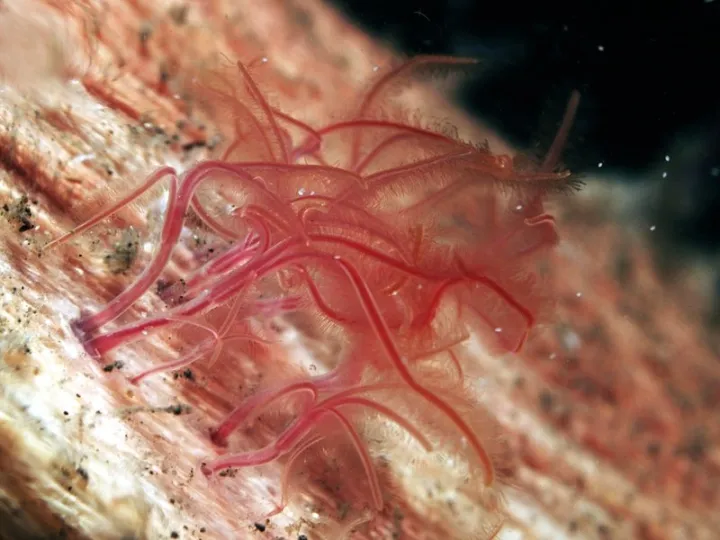
These worms house bacteria within their “roots” that take advantage of the sulfur in the bones to make energy in a process called chemosynthesis. Other bacteria types grow directly on the bones and feed on the sulfur. Up to 190 different types of these bacteria have been found on a single whale carcass, and up to 20 percent of those are also found living around hydrothermal vents.
No two whale fall communities are the same. The size of the whale, the depth of the seafloor, and the location all contribute to the types of animals that colonize the area and determine how long it takes for the skeleton to disappear. Our knowledge of whale falls comes from few and far between ROV and AUV encounters, so though whale falls are scarce, scientists estimate they exist at every 5 to 16 km in the Pacific Ocean.
Hydrothermal Vents
Deep beneath the ocean’s surface, towers spew scalding water from within the earth’s crust. These are hydrothermal vents.
Hydrothermal vents exist in volcanically active areas. Seawater makes its way through the cracks in the earth’s crust until it reaches hot magma. As the water heats it absorbs metals like iron, zinc, copper, lead, and cobalt from the surrounding rocks. Hot water rises, carrying these minerals to the surface of the sea floor. There, it meets cool ocean water, an event that sparks chemical reactions and forms solid deposits. Over time the deposits create towers—forming the classic image of a hydrothermal vent. Some spew water filled with black iron sulfide and are aptly named “black smokers,” while others spew white colored elements like barium, calcium, and silicon and are called “white smokers.”
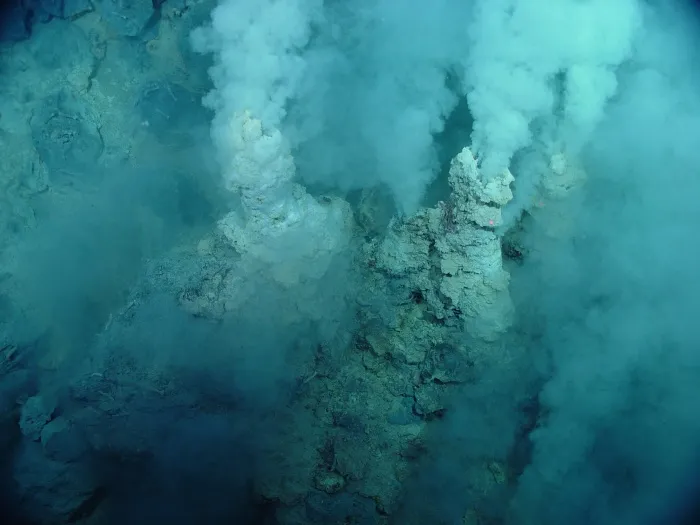
At first inspection, it seems unlikely that anything could live in such an environment—spewing from cracks in the earth’s crust is scalding water that has been heated to temperatures up to 752 degrees Fahrenheit (400 degrees Celsius), a temperature hot enough to melt lead. These vents are also so deep that they never see a glimmer of light from the sun. Despite these obstacles, clams, mussels, shrimp, and gigantic worms thrive in these habitats. Their existence is thanks to bacteria.
Animal life at a hydrothermal vent relies on the energy produced by symbiotic bacteria. The bacteria live either inside the bodies or on the surface of their hosts. But unlike most life on earth that uses light from the sun as a source of energy, these bacteria produce energy through a chemical reaction that uses minerals from the vents.
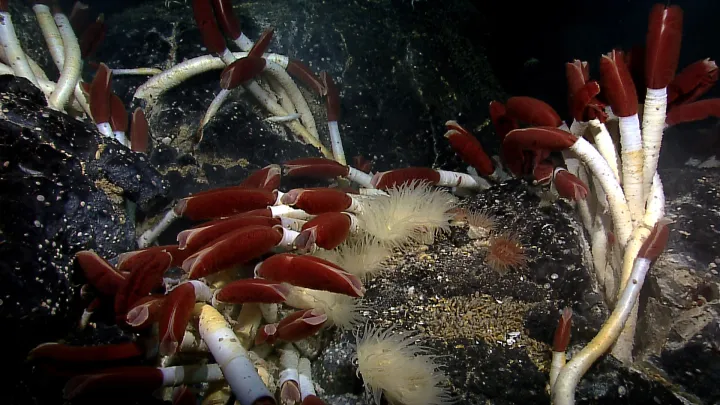
Scientists first learned of these symbiotic relationships through the study of the Riftia tubeworm. Upon first discovering hydrothermal communities in 1977, scientists were perplexed by the diversity and abundance of life. The worm’s blood red plumes filter the water and absorb both oxygen and hydrogen sulfide from the vents. Hydrogen sulfide is normally poisonous, but the Riftia worm has a special adaptation that isolates it from the rest of the body. Their blood contains hemoglobin that binds tightly to both oxygen and hydrogen sulfide. Further investigation into these unique habitats showed that many of the other creatures that live by the vents also rely on symbiotic bacteria. The yeti crab waves its arms in the water to help cultivate bacteria on tiny arm hairs which it then consumes.
Brine Lakes
It seems like an impossibility—coming across a lake at the bottom of the ocean. But due to chemical and physical properties of water, this is, in fact, a reality.
Brine lakes are super salty pools of water that sit on the ocean floor. The extreme saltiness causes significantly denser water than the average ocean water and, like water and air, the two do not mix. The salt difference is so definitive that sitting above the brine lake, you can visibly see the lake’s surface—even waves when the lake is disturbed.
These brine lakes are a remnant of ancient seas that existed when dinosaurs roamed on land. Many brine lakes have been discovered in the Gulf of Mexico. Millions of years ago, during the Jurassic Period, a shallow sea existed where the Gulf of Mexico now sits. Cut off from the rest of the world’s oceans, the sea slowly evaporated, leaving behind a layer of salt up to 5 miles deep in some locations. By the time the ocean returned to that region, sediment had covered the salt, isolating it from the seawater.

But as the Rocky Mountains began to rise and subsequently erode, the extra weight of the sediment flushed into the Gulf of Mexico via the Mississippi River was enough to break the seal. Salt is naturally lighter than soil and as it became squeezed by the soil above, it began to rise. Near the earth’s surface it began to mix with the seawater that was able to percolate into the sediment. This mixture though, was still many times the salinity of ocean water. The result is a brine lake.
Brine lakes are deadly for ocean creatures. The salt content is so high that creatures that “fall in” often die. Their carcass, pickled and preserved, serves as a warning of the toxic landscape below. But for many creatures the risk is worth it. A brine lake is also an area high in methane and certain bacteria can use the methane in a chemical reaction to produce energy. Animals like mussels and crabs come to feed on the special bacteria by the lake’s edge, and often there are whole communities that live along the shore.
Along with the Gulf of Mexico, brine lakes have been discovered in the Red Sea and off the coast of Antarctica.
Cold Seeps
A cold seep is a place on the ocean floor where fluids and gases trapped deep in the earth percolate up to the seafloor. A cold seep gets its name not because the liquid and gas that emerge are colder than the surrounding seawater, but because they are cooler than the scalding temperature of the similar hydrothermal vent.

Cold seeps form at cracks in the earth’s crust. The cracks release buried petroleum-based gas and liquid from deep underground where they formed over millions of years. These liquids and gases are made up of hydrogen and carbon molecules, like methane. It is from these chemicals that cold seep creatures get their energy. Microbes near cold seeps gain energy through chemical reactions, and then pass the energy to symbiotic partners like tubeworms, clams, or mussels. This draws larger predators like octopuses and crabs to the seeps.
Canyons and Seamounts
Like on land, deep canyons can stretch for hundreds of miles across the seafloor. These canyons serve as a habitat where sealife can thrive. The walls, ledges, and bottoms of canyons create a diverse variety of habitats—many of which are steep, and scoured by currents rich in tiny food particles—that enable an array of sea creatures to live there. The rocky ledges are a perfect place for deep sea corals to attach, and the muddy bottom is a soft home for worms and mollusks to burrow. Fish, too, find shelter within the canyon walls, and also a good place to catch a meal.

Canyons are hotspots of life because they are areas of ample nutrition. A canyon acts like a funnel in the ocean, congregating decaying matter that originates from land down to the ocean depths. The geography of a canyon also creates currents of moving water that suspend the amassed nutrition into the water column, often even reaching up into shallower, sunlit depths where photosynthetic algae grow. Krill and crustaceans called amphipods thrive off the phytoplankton, and it is the masses of these zooplankton that attract tuna, swordfish, and sharks to canyons.
A seamount is an underwater mountain that can rise thousands of feet above the seafloor. Just as canyons funnel water, seamounts also influence the flow of water, often diverting deep currents. They are often found at the edges of tectonic plates where magma is able to rise through the surface crust. When dense, nutrient rich ocean currents hit the seamount they deflect up toward the surface, allowing marine life to thrive on the newly supplied food. Crabs, corals, anemones, sea stars, and many other creatures make the walls of seamounts their home. About 80 commercial species live on seamounts, and many are only found near this habitat.
Deep Sea Reefs
It may be the last place you’d expect to find corals—up to 6,000 m (20,000 ft) below the ocean’s surface where the water is icy cold and completely dark. Yet believe it or not, lush coral gardens thrive here. In fact, there are as many known species of deep-sea corals (also known as cold-water corals) as shallow-water species.
Like shallow-water corals, deep-sea corals may exist as individual coral polyps, as diversely-shaped colonies containing many polyps of the same individual, and as reefs with many colonies made up of one or more species. They also serve as a habitat for deep sea creatures like sea stars and sharks. Unlike shallow-water corals, however, deep-sea corals don’t need sunlight. They obtain the energy and nutrients they need to survive by trapping tiny organisms in their polyps from passing currents.

Finding Food
Bioluminescence
In a deep, dark world anything that lights up stands out. But in fact, producing light in the deep is the norm rather than the exception. Some creatures produce their own light to snag a meal or find a mate in a process called bioluminescence.

Bioluminescence first arose roughly 540 million years ago in a group of corals known as the octocorals. Today, animals across the ocean rely on bioluminescence. Animals can use their light to lure prey towards their mouths, or even to light up the area nearby so that they can see their next meal a bit better. Sometimes the prey being lured can be small plankton, like those attracted to the bioluminescence around the beak of the Stauroteuthis octopus. But the light can also fool larger animals. Whales and squid are attracted to the glowing underside of the cookie-cutter shark, which grabs a bite out of the animals once they are close. The deep-sea anglerfish lures prey straight to its mouth with a dangling bioluminescent barbel, lit by glowing bacteria.
In addition to feeding, creatures of the deep use light in flashy displays meant to attract mates. Or, animals use a strong flash of bioluminescence to scare off an impending predator. The bright signal can startle and distract the predator and cause confusion about the whereabouts of its target. The light can even attract a bigger predator that will eat the attacker. If an animal needs to blend in, bioluminescence can be used to help in camouflage with the use of counterillumination, a display of light that helps them blend into the background.
Flashy displays may seem easy to spot, but in the dark expanse of the deep, distance and the immense area can make even bright lights hard to see. Deep sea animals will often have enlarged eyes that can pick up even the faintest light, ensuring a rare encounter leads to a meal or a mating. The Phronima, an invertebrate resembling Ridley Scott’s Alien, uses two sets of eyes, one large set in front and one on the sides. Research that included Smithsonian scientists found that the large eyes allow it to see at longer distances and the smaller eyes provide low resolution vision of nearly the entire area surrounding them, enabling them to catch anything close by.

Vertical Migrations
In the deep-sea food is scarce, but it is also a great place to hide in the dark away from hungry predators. Some creatures have adapted a way of life that takes advantage of both the plentiful surface waters and the safety of the deep. It’s called diel vertical migration.
As the sun sets, fish and zooplankton make massive migrations from the depths up to the ocean’s surface. Despite their small size (some no bigger than a mosquito), these creatures can travel hundreds of meters in just a few hours. Under the light of the moon they feast on the phytoplankton that grew during the day. Then, when the sun comes out and there is enough light for predators to see them again, the zooplankton return to the deep darkness. Often, this repeats every single day. Diel vertical migrations are likely the largest daily migration on the planet.

And while for many creatures partaking in the migration is a way to avoid predators, others take advantage of the reliable movement of potential prey. One tiny plankton, a foraminfera, waits in the path of the migration and ensnares passing copepods, a migrating crustacean, in a web of protruding spines. A layer of these plankton create a dense mine field for the tiny crustaceans to swim through on their path each day. In the arms race of evolution, it pays to be one step ahead.
Diel vertical migrations aren’t the only type of movement between the shallows and deep. Tethered to a life at the surface because they require breathable oxygen, many large animals will make impressive dives to the deep sea in search of their favorite foods. Sperm whales, southern elephant seals, leatherback sea turtles, emperor penguins, and beaked whales are especially good divers. A Cuvier’s beaked whale is known to dive 9,816 feet (2,992 m) deep, and can stay down as long and 3 hours and 42 minutes, making it the deepest diving mammal in the world.
Marine Snow
For much of the deep ocean, food rains down from above in the form of marine snow. The term ‘marine snow’ is used for all sorts of things in the ocean that start at the top or middle layers of water and slowly drift to the seafloor. This mostly includes waste, such as dead and decomposing animals, poop, silt and other organic items washed into the sea from land.

As this material drops deeper and deeper, the particles can grow in size as smaller flakes clump together. The larger size causes them to fall more quickly through the water column—but, even so, the journey to the bottom can take several weeks to years. Scientists have learned more about the travels of marine snow by using sediment traps on the ocean floor. Data from these traps have shown that 815 million tons of carbon reaches the ocean floor every year. These layers of ocean ooze are important carbon sinks—drawing down the decomposing bits of carbon, laying them to rest on the seafloor, and finally burying them.
But not all particles get that far. They are often eaten by fish or marine mammals during their slow fall, just to be digested and pooped out elsewhere in the ocean to begin the cycle all over again. Once the trip is complete, this decomposing hodgepodge can be a welcome food source for animals in deep water and on the sea floor that don’t have reliable food in the sparse darkness. Some animals, such as the vampire squid and its special feeding filaments, have special adaptations to help them better catch and eat the falling particles. The snow is also important to small, growing animals, such as eel larvae, which rely on the snow for months during their development. Marine snow clumps are also swarming with microbes—tiny organisms ranging from algae to bacteria—that form communities around the sinking particles.
Tools & Technology
Technologies for Exploring the Deep
No place on Earth is as distant or as alien as the deep ocean. But we’re now able to explore more and more parts of this remote realm—thanks to a new generation of incredible underwater vehicles.

Some vehicles—known as human occupied vehicles (HOVs)—carry scientists themselves to the deep sea to see firsthand what’s there. Other kinds of unmanned craft let scientists see and study those places they can’t go. For example, scientists can steer remotely operated vehicles (ROVs) from ships at the surface. A cable links the ships to the ROVs, limiting their mobility. Autonomous underwater vehicles (AUVs) have no cable, but they need to be pre-programmed. A new breed of hybrid vehicles (HROVs) combines the best features of ROVs and AUVs: They can have a surface operator, or drop the cable and go it alone.
At the Smithsonian
Deep Reef Observation Project
The Deep Reef Observation Project (DROP) is a Smithsonian research program launched to explore marine life and monitor changes on deep reefs in the southern Caribbean. Scientists turn to submarines to explore at depths too great for SCUBA gear. The Curasub is a 5-person manned submersible capable of descending to 1,000 feet. The state-of-the-art sub is equipped with hydraulic collecting arms that allow for the collection of marine life and the deployment of long-term monitoring devices on the deep reef.
Biological collections from the Curasub off Curaçao have resulted in the discovery of numerous new and rare species of fishes, marine mollusks, echinoderms and crustaceans. This project utilizes the taxonomic expertise of more than a dozen Smithsonian scientists and employs modern molecular tools and digital photography and videography to fully document species and genetic diversity on deep reefs.
Deep Sea Corals
How do you study deep sea coral reefs? With a submarine. Museum curator Andrea Quattrini has spent her career using submarines and remotely operated vehicles to document coral reefs and the species that call these underwater “forests” home. While coral reefs in shallow water are well studied and loved by people, very little is known about their deep sea relatives. We do know that many commercially important species like shrimps, crabs, groupers, rockfish, and snappers rely on deep sea coral reefs for shelter, but this is only based upon a limited number of studies and dives. Scientists, including Quattrini, continue to discover additional species that call deep sea coral reefs home, showing that there is still much to learn about the deep sea.
Living in the Deep Sea
What does it take to live in the deep sea? Curator Karen Osborn wants to know how and why animals adapt in order to survive in a cold, dark, and pressurized environment. Many animals that live in this largest of the earth's habitats are very bizarre and dramatically different from their closest relatives. For example, some make an extreme effort to see, building huge bulbous eyes that can detect even the smallest glimmer of light, while others completely forfeit any form of sight and instead rely on heightened scent and touch. Since most animal groups have representatives living in the open ocean, learning about the differences in the way these animals live compared to their relatives in shallow water tells us a lot about how this environment changes and shapes the many animals that survive there.