


Giant Squid
Introduction
Giant squid live up to their name: the largest giant squid ever recorded by scientists was almost 43 feet (13 meters) long, and may have weighed nearly a ton. You’d think such a huge animal wouldn't be hard to miss. But because the ocean is vast and giant squid live deep underwater, they remain elusive and are rarely seen: most of what we know comes from dead carcasses that floated to the surface and were found by fishermen.
But after years of searching, in 2012 a group of scientists from Japan's National Science Museum along with colleagues from Japanese public broadcaster NHK and the Discovery Channel filmed a giant squid in its natural habitat for the first time. The species was first recorded live in 2006, after researchers suspended bait beneath a research vessel off the Ogasawara Islands to try and hook a giant squid. As the camera whirred, the research team pulled a 24-foot (7-meter) squid to the surface alive enabling people around the world to finally see a living, breathing giant squid.
Anatomy, Diversity & Evolution
Anatomy
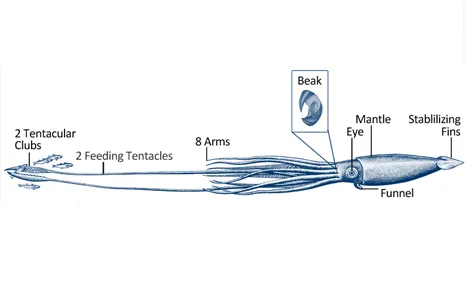
A giant squid’s body may look pretty simple: Like other squids and octopuses, it has two eyes, a beak, eight arms, two feeding tentacles, and a funnel (also called a siphon). But, of course, all of it is much larger!
FEEDING TENTACLES
Giant squid can snatch prey up to 33 feet (10 meters) away by shooting out their two feeding tentacles, which are tipped with hundreds of powerful sharp-toothed suckers. These feeding tentacles are very long, often doubling the total length of the giant squid on their own.
ARMS AND BEAK
Eight thick arms speckled with 2-inch wide toothed suckers guide prey from the feeding tentacles to a sharp beak in the center of the arms, where the prey is sliced into bite-sized pieces. These bites are further cut and ground by the radula, a tongue-like organ covered with rows of teeth, that is inside the squid's beak.
The head holds eyes the size of dinner plates -- the largest in the animal kingdom. At 1 foot (30 centimeters) in diameter, these huge eyes absorb more light than their smaller counterparts would, allowing the squid to glimpse bioluminescent prey -- or sight predators lurking -- in the dark. The squid's complex brain, which is tiny compared to its body, is shaped like a donut. Strangely enough, its esophagus runs through the "donut hole" in the middle, which makes grinding up food into tiny bits an evolutionary priority.
BODY AND FUNNEL
The main part of the body, or mantle, contains all the basic organs. And on the body’s underside is the funnel—an amazing multipurpose tool. By pumping water and other fluids through the funnel, the squid uses it to exhale, expel waste, lay eggs, squirt ink, and move through the water by jet-propulsion.
Size and Strength
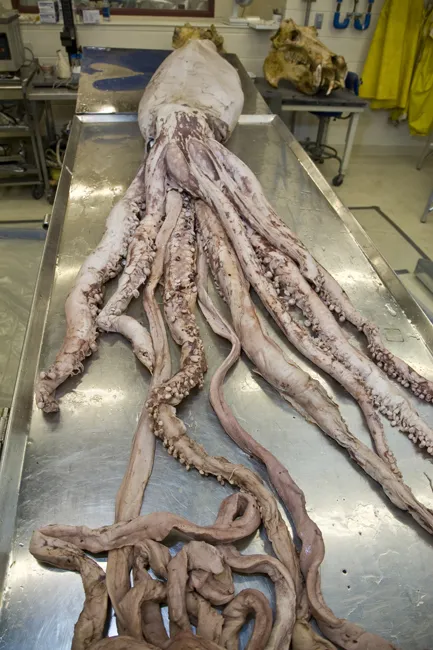
Giant squid are big—but just how big are they?
Unfortunately, the reports of their size are often exaggerated since finding a live giant squid is an extremely rare event. Almost everything people know about giant squid comes from specimens washed up on beaches. Sometimes their tentacles or arms have fallen off, or have been eaten by other animals while afloat in the ocean. On the other hand, when they wash ashore, the squids can be bloated with water, appearing bigger than they really are.
Because tentacles and arms fall off or, alternatively, can be stretched out, scientists often use mantle length as the best measure of a squid's actual size. The longest mantle length on record is 7.4 feet (2.25 meters); the length from the tip of the top fin to the end of the arms rarely exceeds 16 feet (5 meters), and the longest total length (including tentacles) of a squid on record is 43 feet (13 meters). A new method for figuring out how big a squid can get includes using beak size to estimate total body length, a helpful tool considering the hard beaks are often found in the stomachs of sperm whales. Based on this new method scientists believe the giant squid could reach lengths up to 66 feet (20 meters) long, making it potentially larger than the colossal squid, however, a real-life squid of this size has never been documented.
But does a big giant squid necessarily mean a strong one? If they were proportionally as strong as their smaller cousins, the Humboldt squid (Dosidicus gigas), giant squid would be VERY strong, says Smithsonian squid expert Clyde Roper. "However, their muscular structure, density and fluid composition indicate that they are not nearly that strong," he says. However, that doesn't make them sluggish weaklings. They have thousands of suckers working in unison on eight arms and two tentacles, with a rapidly-contracting mantle, to help capture and kill prey.
Diversity and Evolution
Squid Diversity

The giant squid is not just a single species -- or is it? Some researchers think there are as many as 8 species in the genus Architeuthis (Greek for "chief squid"), each a different kind of giant squid. But other researchers think there is just one Architeuthis that swims in the world's ocean. There is no consensus because the squid are so hard to track and there are so few specimens available for study.
However, it is certain that Architeuthis has an abundance of evolutionary relatives. The ocean holds an estimated 500 species of squid—and almost all of those are in the same taxonomic order as the giant squid, called Oegopsina. Some are surprisingly tiny—only about 1 inch (2.5 centimeters) in length. Others are impressively large, including the colossal squid (Mesonychoteuthis hamiltoni), which can grow to be even bigger than the giant squid, reaching 45 feet (14 meters).
These squid species are closely related to snails, clams, and even slugs: they are all mollusks, which are defined by their soft bodies. Some of these soft bodies are encased in hard shells, such as clams and snails, but not the squids.
Squids belong to a particularly successful group of mollusks called the cephalopods, which have been around for about 500 million years. Some ancestors of modern-day squids had shells, such as the ammonites, which ruled the waves 400-65 million years ago. Of those that are still around, one small group—the nautiluses—has an external shell. The other—which includes squids, cuttlefishes, and octopods—does not, although squids and cuttlefishes have an internal, backbone-like support made of chitin called a pen.
Shell or no shell, all cephalopods have well-developed brains and are very active, jet-propelling themselves through the ocean. Most have ink sacs. And many can change skin color and texture in the blink of an eye.
Ecology & Behavior
Distribution

Giant squid are thought to swim in the ocean worldwide, based on the beaches they've washed upon, as shown in the map (via Wikimedia Commons). However, they're rarely found in tropical and polar areas. They commonly wash up on the shores of New Zealand and Pacific islands, make frequent appearances on the east and west sides of the Northern Atlantic, and the South Atlantic along the southern coast of Africa.

This distribution suggests that they prefer continental and island slopes, says Dr. Clyde Roper.
Lifecycle
Growth
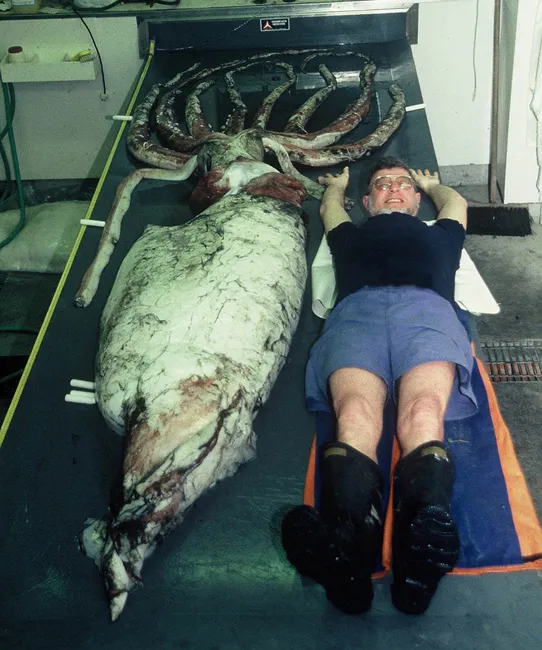
How long does it take to grow so big? Unlike mammals, including people, and many fish species, cephalopods grow very quickly and die after a short life. Evidence from statoliths (a small mineralized mass that helps squid balance), which accumulate "growth rings" and can be used to measure age, suggests that giant squid live no more than five years -- which means each squid must grow incredibly quickly to reach 30 feet in just a few years! To grow at such a rate, giant squid must live in areas of the ocean where there is an abundant supply of food to provide enough energy.
Reproduction
It’s believed that giant squid live about five years and, in that time, reproduce only once. Talk about pressure! Giant squid males don't use a modified arm (hectocotylus) to transfer sperm like most squid; instead, the spermatophore (sperm packet) is expelled from a penis, which sticks out through the funnel and can be as long as the animal's mantle, up to 7 feet long. Once the male finds a female -- whether it happens by chance or by following a chemical signal is unknown -- the male injects sperm packets directly into the female's arms.
The rest of the story from here is mostly guesswork. The sperm could travel through her arms to fertilize the eggs internally. But researchers suspect that the arm-shot of spermatophores triggers the female squid's ovaries to release eggs bound together with jelly, which she holds in her arms. Then the sperm sense the eggs nearby and migrate in that direction to fertilize the eggs.
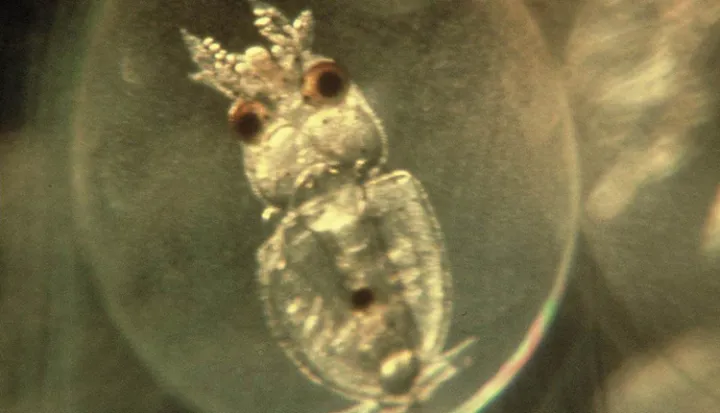
Females then release millions of tiny, transparent fertilized eggs into the water in a jellied clump called an egg mass. Most are quickly snatched up as food by other marine animals. But a few survive -- and within a few years, they become giant marine predators.
In the Food Web
Feeding

Hunting in the deep dark ocean isn't easy, but these cephalopods have adapted to their environment. In addition to their foot-wide eyes, which help them to absorb as much light as possible to glimpse prey, they also have long feeding tentacles. These tentacles are more than twice their body length, and the squids can shoot out to long distances like a net. This allows these big, comparatively conspicuous squids to sneak up and catch prey. But what do giant squids eat? Although scientists have not witnessed a giant squid feeding, they have cut open the stomachs of squids washed up on beaches to see what they had eaten recently. Giant squid mostly eat deep water fishes and other squids—including other giant squids. They also will attack schools of fish from below, quickly ascending into shallower waters to grab a meal before retreating to safer depths away from predators. Once prey is caught by the suckers and teeth on the feeding tentacles, the squid will rein it in and bring it towards its beak with its eight arms. The beak breaks the food down into smaller pieces, and the radula, a tongue-like organ covered in teeth, grinds it down further. Then the food goes down the esophagus —which travels through the squid's brain—to get to the stomach. Evidence from a washed ashore squid suggests giant squid will steal the captured meal of another squid, presumably in order to reduce the risk of an attack by a sperm whale in shallow depths. The dead squid's two tentacles were ripped from their base and large sucker marks covered the mantle.
Predators

One hypothesis for how giant squid evolved to grow so enormous is that the tremendous size leaves it with few predators in the deep water. However, those predators still exist—most notably the sperm whale. Scientists have found giant squid beaks, as well as other undigested pieces of giant squid, in the stomachs of sperm whales—the remains of a very large serving of calamari. Additionally, beach-stranded sperm whales have been found with sucker marks on their skin, battle scars large enough that only a giant squid could have caused them.
Who wins in these battles? It's hard to know, since these duels have never been seen by people, but most likely the sperm whales emerge victorious. The small sampling of giant squid stomachs have never contained any recognizable sperm whale parts, but many sperm whale stomachs have contained giant squid. And the only way a whale develops a battle scar is if it survives the battle.
Squids at the Smithsonian
Meet Clyde Roper

Dr. Clyde Roper grew up close to the ocean and was a lobster fisherman before going to graduate school, where he studied squid. “I was hooked,” he says. Roper is especially passionate about giant squid and has traveled the world studying dead specimens on beaches and in museums and searching for living squid. In his quest to learn as much as possible about giant squid, Roper has been bitten by several species of squids and tasted a piece of cooked giant squid. “It was really awful,” he says. A zoologist at the Smithsonian’s National Museum of Natural History, Roper has discovered new cephalopod species, published more than 150 scientific papers, and co-authored the Catalog of Cephalopods of the World. He hasn’t yet seen a living giant squid—but he hasn’t given up on this long-held dream.
Giant Squid on Display

There are about a dozen giant squid on display in museums and aquaria around the world, and the Smithsonian’s National Museum of Natural History is lucky enough to have two.
This female (the bigger of the two) was caught in a fisherman’s net off the coast of Spain in 2005. It was probably 2-3 years old and, when alive, 11 meters (36 feet) long with tentacles that extended 6.7 meters (22 feet). Since then it has shrunk considerably, but at 7.6 meters (25 feet) long, it is still an impressive sight.
How do you transport a giant squid carcass from Spain to Washington, D.C.? With the help of the U.S. Navy and U.S. Air Force for Operation Calamari. Displaying specimens of this size is a challenge―so much so that specially designed tanks had to be designed. The tanks hold between 1,500 and 1,800 gallons of water, are completely airtight, contain valves and openings for refilling preservative fluid when necessary and taking tissue samples, and are equipped with appropriate gear for anchoring all body parts and tentacles to prevent floating. International shipping regulations prohibit transportation of hazardous materials in an airplane. The squids could not begin their journey until their tanks were completely finished and ready to receive them. Once that was done the specimens were wrapped carefully in cheesecloth and crated tightly for their trip. Several squid specialists accompanied them on their flight and as soon as they arrived, they were met by Smithsonian personnel and immediately installed into their new quarters at the ocean hall.
This specimen and a smaller male are on loan to the Smithsonian from the Coordinadora para el Estudio y la Protección de last Especies Marinas, which preserves giant squid specimens from the waters of northern Spain.
Collections
200,000 Cephalopods and Counting

The Smithsonian doesn't just house giant squid; scientists at the Smithsonian’s National Museum of Natural History are building a National Cephalopod Collection. It already totals about 200,000 preserved specimens collected worldwide—including the most diverse collection of squids found in the world. The museum’s collection also includes the holotypes for 164 cephalopod species, including 66 squid species. Holotypes are the specimens that were used by scientists to formally describe and name a new species.
Research
Search for the Giant Squid

If you want to see a live giant squid, you have to go to where it lives. That happens to be the inky black, icy cold waters 1,650 feet (500 meters) to 3,300 feet (1,000 meters) below the ocean’s surface—not a very convenient place to watch wildlife. Dr. Clyde Roper, a Smithsonian zoologist, has tried several techniques to track down giant squid in their natural habitat. With help from the National Geographic Society, he attached a small video camera called Crittercam to the heads of sperm whales. He sent a camera-equipped, robotic submersible called an Autonomous Underwater Vehicle to search for giant squid. And he has dived thousands of feet alone in a deep sea submersible.
So far, no luck for Dr. Roper. But researchers in Japan were able to film a giant squid in its natural habitat in 2012 using flashing lights to imitate bioluminescent jellies (Watch the footage at the Discovery Channel). In 2019 the giant squid made an appearance again, this time off the coast of Louisiana. A National Oceanic and Atmospheric Administration (NOAA) funded project lured the squid with a special probe and caught the squid on camera.
Cultural Connections
Giant Squid of Myth

The giant squid has captured the human imagination for more than 2,000 years. For a long time, people who spotted them floating, dead, at sea or washed up on beaches couldn’t figure out what they were. Were they monsters or sea serpents? Mermen? Rare glimpses of this huge sea creature inspired both fear and fascination. People came up with fantastic explanations for what their astonished eyes saw—or thought they saw. Movies, books, and popular lore featured encounters with huge, hungry sea creatures brandishing many tentacles. It turns out that the giant squid of myth is not a monster at all. But only since the late 19th century has enough scientific evidence accumulated to replace the myths with fact.
From Mermen to Architeuthis

The first known record of Architeuthis comes from Denmark in the 1500s, when several "curious fish" were found afloat by the sea. Historians of the time did not associate these "fish" with cephalopods; instead, they conflated their looks with those of humans, describing these creatures as having "a head like a man... and a dress of scarlet like a monk's cloak," and calling them Sea Monks.
Not until the mid-1800s did the leading cephalopod specialist of the day, Professor Japetus Steenstrup of Denmark, conclude that the mythical beasts were, in fact, very large squid. With the two long feeding tentacles arranged just right, they could be mistaken for arms sticking out of the mantle. The rest of the Sea Monk descriptions, however, he ascribed to a combination of astonishment and imagination. "Squids on the whole make a grim impression on all those who are not accustomed to seeing them more frequently," Steenstrup said. "Those animals aroused still greater astonishment in earlier times."
The First Photograph
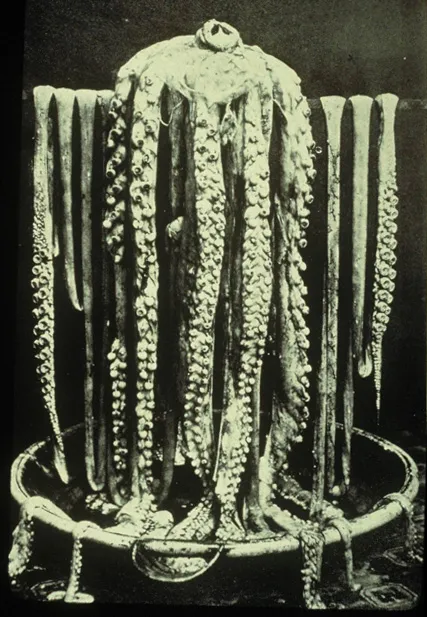
In late 1873, Reverend Moses Harvey of Newfoundland, an amateur naturalist and writer with an intense interest in curiosities from the sea, bought a dead giant squid for $10 from a fisherman who caught it by accident. Harvey immediately displayed it in his living room, draping the head and arms over the sponge bath for easy observation. It was the first complete giant squid specimen ever put on display, and it became a turning point in our understanding of giant squid. Professor A.E. Verrill of Yale University used Harvey’s “curiosity” to provide the first accurate description and scientific illustration of the giant squid.
A Man-Killing Monster?


Even before Harvey's giant squid carcass made the news, fiction writers had been incorporating Architeuthis into their stories. Perhaps most famously, French author Jules Vernes's 1870 novel 20,000 Leagues Under the Sea features a monster squid with a hunger for human flesh. A "poulpe" -- French for "octopus" but commonly translated as "giant squid" -- attacks the submarine Nautilus, putting up quite a fight and devouring a crew member. Verne describes the 25-foot squid as "a terrible monster worthy of all the legends about such creatures" and, in the process, created a legend himself.
For the 1954 film version of the novel, Disney created a two-ton model squid, requiring 16 men to operate the remote controls and 50 more to move the wires attached to tentacles. Their model squid pales in comparison to modern day film monsters, but it earned the movie an Academy Award for special effects.
Giant squid have made other book and film appearances. In Doctor No, the sixth novel in Ian Fleming's James Bond series, a giant squid attacks Bond while he's trapped in a pool. And in the 1991 Peter Benchley novel Beast (made into a film in 1996), researchers and monster hunters go after a 100-foot squid, which is finally killed when a sperm whale bites off its head.
Additional Resources
Online:
An article written by Clyde Roper at the Tree of Life web project
Architeuthis history and mythology
Profile of Clyde Roper in Smithsonian Magazine
The giant squid at the National Museum of Natural History: where did it come from, how did it get here, and how is it displayed?
Articles:
The Squid Hunter (The New Yorker)
Books:
Cerullo, Mary and Clyde Roper. Giant Squid: Searching for a Sea Monster. Mankato, MN: Capstone, 2012.
Ellis, Richard. The Search for the Giant Squid. New York: Penguin, 1998.
Williams, Wendy. Kraken. New York: Abrams Image, 2011.