Plants & Algae

LATEST TODAY'S CATCH

Dancing Bulb

May 7, 2013 - 9:45AMThis beautiful bromeliad, also called an air plant because it gets its nutrients and water from the air, is a flowering plant in the pineapple family. All of them are epiphytes, meaning they get their support from and grow on...
Feb 20, 2013 - 10:16AM
A strain of this green seaweed, native to the Indian and Pacific Oceans,...
Feb 5, 2013 - 11:08AM
Sargassum fluitans, a.k.a. “Gulfweed,” forms dense clumps up to the size of...

SPOTLIGHT

Scientists Work to Predict and Prevent Algae Blooms

Algae, like all organisms, normally grow in balance with their ecosystems, limited by the amount of nutrients in the water....
Feb 11 2013 - 1:53pm
It is a well-known fact that for animals living in the deep sea, food can be scarce. The food that is around usually rains down from above as dead animals and organic particles from plankton living near the ocean’s surface. Occasionally, a bonus in the form of a good-sized dead fish, a porpoise, or...
Dec 16 2011 - 11:16am
“Sea grapes” may sound like something Poseidon would snack on, and not a killer algae. Yet Caulerpa racemosa var. cylindracea poses a serious threat to marine life. Spread by the bilge water of boats, this fast-growing alga is quick to take root, squeezing out native species.
Jul 26 2011 - 11:45am
Macroscopic algae (Ventricaria ventricosa), also known as "bubble algae" or "sea pearl," is widespread algal species that can withstand low light. Each of the bubbles is a single cell, making it one of the largest single-celled organisms known, reaching up to 5 centimeters in diameter. They are...
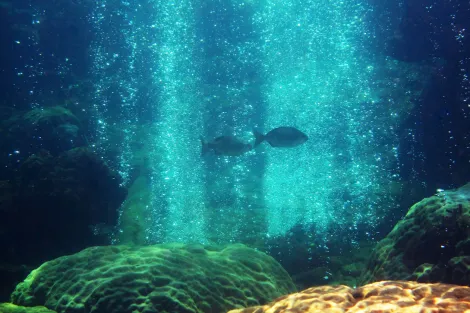
Very close to the seeps pH is lowest and water is most acidic. Corals cannot grow in these conditions - only seaweed can.
Aug 2 2012 - 3:34pm
Nestled among the beautiful coral reefs of Papua New Guinea (PNG) is a place that could provide the key to our understanding of one of the biggest threats to coral reef survival: Ocean Acidification. Here cool carbon dioxide naturally bubbles out of volcanic cracks in the shallow sea floor and...
Check out the array of tiny shrimps, fishes and nudibranchs that call this sargassum algae home.
May 18 2012 - 4:43pm
Smithsonian Marine Science Network Postdoctoral Fellow, Seabird McKeon, returns from the Smithsonian field site in Belize. Together with Dan Barshis of Stanford University, Seabird reports on the seemingly invisible inhabitants of drifting sargassum seaweeds. As with many parts of the ocean, a ball...
Feb 5 2013 - 11:08am
Sargassum fluitans, a.k.a. “Gulfweed,” forms dense clumps up to the size of a beach ball that slowly rotate as they drift. The fronds are quite dense, but if you look carefully, sometimes you can see hints of the rich community that hides in the floating sargassum.
Jan 26 2010 - 11:45am
Macroscopic Algae (Acetabularia crenulata). More about mangrove ecosystems can be found in the Mangroves section.