


Sustainable Fishing
Introduction
Humans across the globe rely on the ocean as a main source of food. We enjoy fish fillets baked, battered, and stuffed, wrapped in rice and seaweed, and skewered kabob style. Shellfish cracked open reveals tender bites of meat, and squid arms make for an enticing meal. Seafood is for everyone—whether it’s a high-end meal, or a daily staple. Many people rely on seafood as a way to make a living, as fishers or fish farmers.
Ensuring the oceans continue to thrive while also feeding the world’s people requires an understanding of how many fish are harvested. Fishing can either be sustainable, where the number of fish taken from a population is at a rate that allows the stock to repopulate, or it can be unsustainable, where fishing removes more fish than can regrow. When compared to many land-based sources of food, responsibly managed seafood is a sustainable source of food with minimal environmental impact. According to the Food and Agriculture Organization (FAO) of the United Nations, about 79 percent of seafood is sustainable. However, not all fishing practices are exemplary, and there is a limit to how much we can take from the ocean. Some fish populations are feeling the pressure from our dependence on seafood, and climate change and human development are adding to that stress.
In a world where the human population is rapidly growing, seafood is essential to combatting food scarcity. The best way to ensure the sustainability of this resource is responsible management, fishing, and farming. The way we harvest and consume fish affects the health of ocean ecosystems. As a consumer, choosing sustainably caught or farmed fish helps ensure that future generations can both enjoy and rely on plentiful and diverse oceans. Luckily, there are plenty of options to choose from.
Defining Sustainability
What is Sustainable?
Sustainable seafood is seafood harvested or produced in a way that supports productive fisheries and coastal communities and also maintains healthy ecosystems. A fishery is the harvesting of a specific population of fish using a specific method of collection. There is no hard and fast rule associated with the term “sustainable seafood,” rather, governments, nonprofits, and international agencies develop scientifically based standards that aim to guide responsible fishing practices and consumer habits. There are many factors that determine whether a fishery is sustainable or not. One important factor is determining approximately how many fish can be removed from a population over time while still allowing it to mature and repopulate. Scientists use a variety of tools to estimate and monitor a species’ population size, then work with managers to set harvest limits and track how many fish are being caught.

According to the FAO, about 60 percent of the world’s fish stocks are fully fished, meaning they are right at the limit of sustainability, 33 percent are overfished, and about 7 percent are underfished. In 2019, roughly 179 million tons of fish were harvested, either by fishing or from aquaculture. Fish feed billions of people and support an industry worth 401 billion U.S. dollars—they are an integral part of our lives.
But sustainability is more complicated than it seems. Some species are more resilient to fishing and other pressures such as temperature swings due to climate change, habitat degradation, and pollution. For example, species that reach sexual maturity faster or reproduce more offspring, are often better able to maintain their population. The orange roughy and the humphead wrasse (also known as the Napoleon wrasse) are fish that have suffered because scientists and the public were unfamiliar with their reproductive cycles.
Sustainability also looks at how fishing for a specific fish species will impact the ecosystem it lives in. Some fishing gear is more harmful to the environment than others, whether because it has a likelihood of catching other species (bycatch) or because it destroys the surrounding environment (such as the impact on seafloor ecosystems from dredging). Some fish also play an important role in maintaining the population balance within an ecosystem, and even the slightest loss in numbers will trigger a cascade of effects on other species. All these factors contribute to whether a fishery is sustainable or not.
Who Defines Sustainability?
There are numerous organizations and governmental councils that assess fisheries for sustainability. Internationally, responsible fishing practices are guided by the United Nation’s Code of Conduct for Responsible Fishing, a set of principles that help nations govern and implement fishing practices that keep conservation in mind.
Most fishing occurs in a country’s exclusive economic zone (EEZ), the area that extends 200 nautical miles off the coast from shore. In this area fishing practices are governed by the corresponding nation. But fish don’t pay attention to international borders, and the majority of the ocean is not owned by any one nation, rather, it is open for anyone to fish. This area, known as the “high seas,” has been particularly difficult to regulate since countries that have fishermen in these areas often have differing sustainability policies.
For these international waters, nations can form agreements called Regional Fisheries Management Organizations to help manage the fisheries. These agreements bind participating countries to a set of rules that may mandate the types of gear that can be used or limit the number of fish that can be caught. Despite these agreements, it is still difficult to enforce conservation measures, though significant progress has been made in reducing bycatch and addressing illegal fishing.

In the United States, the fisheries office of the National Oceanic and Atmospheric Administration, known as NOAA Fisheries or the National Marine Fisheries Service, is responsible for assessing and enforcing fishing practices that occur within U.S. waters. This office looks to the Magnuson-Stevens Act (1976) to determine how to govern the management of fisheries. The act aims to prevent overfishing, rebuild overfished stocks, improve long-term economic and social benefits, and safeguard a steady supply of seafood harvested in a safe way. Eight governing Regional Fishery Management Councils update their local fishery management plans using input from fishers and the public. They refer to a 10 point system of principles to follow when considering the management of a particular species.
Most major fisheries in the United States are considered sustainable by NOAA, and others are in the process of rebuilding. As of 2019, 93 percent of commercially and recreationally important fish stocks are being fished at sustainable levels in the United States. Fisheries and aquaculture provided roughly 1.74 million jobs and grossed over 244.1 billion in sales.
Fisheries Management
In order to help regulate fishing practices and promote sustainability, countries and local governments rely on systems of fisheries management. Managing fish stocks requires the cooperation of local communities and their government to make and enforce policies that prevent bycatch and overfishing. They likely also include plans to rebuild overfished species and protect habitat. It can be a very daunting task.
Management regulations can include catch quotas, limiting the length of a fishing season or number of available licenses, fishing gear restrictions (e.g. mesh size of net), mandatory use of gear attachments to reduce bycatch, required training in best practices, and designated no-fishing areas. Monitoring and enforcement of these regulations is also essential for a successful management plan. Historically fisheries management practices were single-species focused, aiming to maximize catch of that species. More and more, though, fisheries are striving towards a new direction of management called Ecosystem-Based Management. This holistic form of management goes beyond managing a single species and also considers how removing a species impacts its predators and prey, if any endangered or threatened animals are caught incidentally, the impacts of fishing gear on essential habitat, and if ecological processes are being negatively impacted.
Management Challenges and Opportunities
Illegal, Unreported, and Unregulated Fishing
Illegal, unreported, and unregulated (IUU) fishing is the ocean equivalent to the illegal wildlife trade of ivory elephant tusks, rhino horns, and tiger skins. It is one of the biggest factors contributing to overfishing and can negate much of the hard work of management. A 2009 study estimates that between 11 and 26 million tons of fish, valued at 10 to 23.5 billion dollars were illegal or unreported in each year between 2000 and 2003.
A global problem, IUU fishing violates existing conservation and management measures like fishing in areas outside of a vessel’s legal jurisdiction, tax and tariff evasion, failing to report catch, and more. IUU fishing not only accelerates unsustainable harvest, but it also undermines legal markets and compromises food security. IUU fishing has also been linked to indecent working conditions, slavery, piracy and illegal drug and human trafficking operations.
Fishing’s biggest problem is the illegal stealing of fish from a country’s exclusive economic zone (EEZ). In this scenario, foreign boats fish in an EEZ without the country’s permission. Most stealing occurs by wealthy countries in a poor country’s territory. Over 40 percent of illegal fishing occurs off the coast of Western Africa. Many of these nations lack the resources to adequately patrol their area of jurisdiction and enforce regulations. There is cause for hope—a new tool that tracks fishing boat movement aims to out illegal fishing and put pressure on their home countries to punish illegal practices.
Unreported fishing is also a form of illegal fishing. It is specifically harmful to the creation of accurate catch limits and can cause future overfishing of a fish population. Since a catch limit is determined using the previous year’s amount of caught fish, an inaccurate report can lead to unsustainably high limits in future years.
Most unregulated fishing occurs beyond exclusive economic zones in international waters known as the high seas. Although regional fishery management organizations were established to manage some areas, about 40 percent of the high seas lack management policy. Fishing in international waters continues to be controversial, and in 2020 the United Nations is in the process of initiating an international agreement concerning fishing in the high seas.
Bycatch
Every year, about 10 million tons of unintentionally caught fish are discarded in the fishing process. Many of these marine animals become trapped in fishing gear but are not the intended catch. This unwanted catch, referred to as bycatch, usually dies. Sometimes the bycatch are fish too small to sell, other times it consists of animals such as sea turtles, sharks, dolphins, seabirds, and even whales. Bottom trawling for shrimp and longlining produce some of the highest bycatch rates. In some cases, such as bottom trawl shrimp fisheries, bycatch can be 3 to 15 times higher than the target catch. Many fisheries have successfully reduced bycatch by using appropriate gear technologies and fishing practices.

Technological advancements are helping to prevent bycatch. The "Turtle Excluder Device," or TED, is one example. It allows turtles like the endangered loggerhead sea turtle to escape from trawl nets through a grid of bars at the top or bottom of the net. In some fisheries, such as the Australian Northern Prawn and Torres Strait Prawn fisheries, TEDs are mandatory. The attachment is a solid grid that directs larger animals such as turtles, sharks, and stingrays out and away from the back of the net. After their introduction in this fishery, turtle bycatch decreased as much as 99 percent.

Birds, too, are susceptible to getting caught in fishing gear. Albatross, large birds with massive wingspans, commonly get caught in longline gear. Enticed by the bait on the long hooks and lines, they can get pulled underwater and drown.
Now, fishermen are turning to bird scaring lines to help deter the birds from going after their bait. And the solution is simple—as the lines are being set the fishermen attach brightly colored streamers that scare away the birds. One of the most successful implementations of bird scaring lines is in South Africa. Between 2006 and 2014 total bird bycatch in the trawl industry decreased by 90 percent, and by 99 percent for albatross. The success of South Africa is now the source of inspiration for many other countries.
Ghost Gear
Fishing gear serves a purpose to trap fish for the eventual collection by fishermen. But sometimes that gear gets lost at sea, whether due to an accident, abandonment, or a storm that dislodges it from its anchor. When this occurs the fishing gear becomes derelict, sometimes known as “ghost gear.” Ghost gear continues to entrap fish, often killing animals when they are unable to escape. The gear can also ensnare other creatures like whales and turtles and damage the environment.
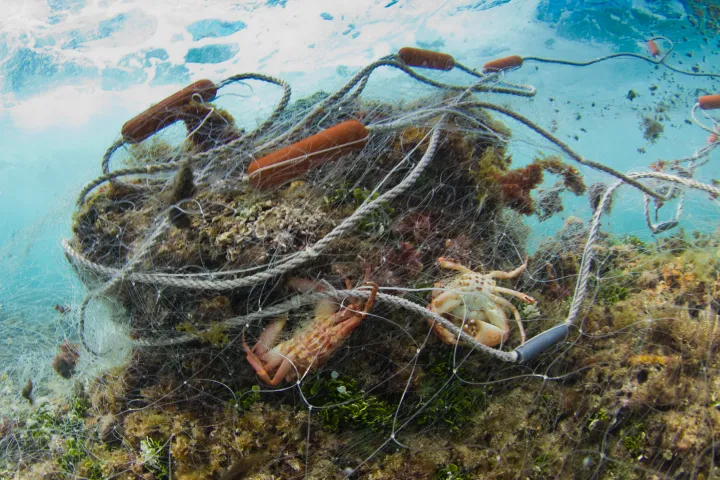
One common type of ghost gear is the crab pot. Roughly 85,000 ghost pots exist in the Florida Keys, killing an estimated 630,000 lobsters every year. In Louisiana, about 450,000 pots used to catch blue crab are lost. In the Chesapeake, that number is about 160,000, and an estimated one million crabs die in Virginia’s portion of the bay. Out of the three million lobster traps that are set along the Maine coast, about 10 percent are lost every year. Not only does ghost fishing harm local ecosystems, it negatively impacts the success of fisheries. One study estimates that removing just 10 percent of derelict crab and lobster traps worldwide could increase the value of seafood caught by $831 million dollars a year.
Some traps now have a dissolvable panel that only begins to decay if left in the water for an extended period of time. The Maine lobster fishery devised both an escape route for lobsters too small to be legally sold and a dissolvable hatch called a “ghost panel” that releases trapped lobsters after 6-12 months underwater. And the Virginia Institute of Marine Science has been experimenting with its own dissolvable panel that could be used in the Chesapeake Bay and Gulf of Mexico.
Aquaculture
As the global human population continues to grow, so does the demand for food—including seafood. Aquaculture, the farming of fish, shellfish, seaweed, and aquatic veggies, can help to ensure enough seafood for the demands of global consumption. Like fishing, aquaculture can be managed in a sustainable or unsustainable manner. Environmentally friendly practices consider the location of the farm, the species being farmed, and the types of methods used. When responsibly operated, a farm limits disease, waste accumulation, habitat damage, escapees into the wild, and also uses a sustainable fish feed.
One of the biggest challenges facing aquaculture is the use of sustainable fish feed. Many favorite farmed fish, like salmon, are carnivores and require a diet high in protein. Historically, this protein was provided in the form of wild caught anchovies or sardines. More and more farmers are turning to alternative feeds that are based on soy or seafood byproducts.
Despite these challenges, the future of aquaculture is bright. Much of the aquaculture farms in the United States are shellfish farms, including mussels and oysters. These bivalves, shellfish with two clasping shells, filter the water and have an overall beneficial effect on the surrounding habitat because they clean the water of waste. Farmers of Atlantic char now successfully grow them in land-based tanks that rely on water filtration systems. Separated from the ocean, this type of aquaculture limits contact with wild populations and contains wastes and byproducts. Farmers are also experimenting with this type of closed system to grow other types of fish. Other sustainable measures include farms that have multiple species, like sea cucumbers that eat the waste of fish above, deep, floating cages that allow plenty of waterflow, and vaccinating fish instead of using antibiotics.
Seafood Fraud
Mislabeling and substitution in fish markets and behind the seafood counter occurs for several reasons. This seemingly simple action can be a potential health concern as some seafood carries more contaminants, toxins, or allergens than others. Though mislabeling sometimes occurs due to mistaken identity, fish are also mislabeled on purpose to make a profit—a cheap fish is sold under the name of a more expensive fish. It can also allow sellers to falsely meet market demand. Some commonly mislabeled and substituted species in the U.S. include red snapper, which is substituted with Pacific Rockfish or other kinds of snapper, mahi mahi, which is substituted with yellowtail amberjack, and swordfish, which is substituted with mako shark. Some non-profit and advocacy groups are promoting the idea that species be traced throughout the entire supply chain by their species name. The Marine Stewardship Council (MSC), a nonprofit that sets standards for sustainable fishing, uses DNA testing to ensure seafood sold under their label is the species it claims to be.

To help with accurate seafood identification and labeling, the Food and Drug Administration (FDA) maintains a Regulatory Fish Encyclopedia that includes acceptable market names of seafood in the U.S., along with corresponding high-resolution images of the whole fish, fillets and other information. Also, check out the Smithsonian’s role in DNA barcoding below.
The extent of mislabeling varies by location and species and can include an inaccurate species name or even country of origin. To date, a comprehensive, large-scale study on frequency and extent of mislabeling and substitution has not been completed. Fraud statistics vary depending on location and sample size. For example, one study concluded that 16 percent of sampled seafood was mislabeled in select U.S. cities, another showed 20 to 25 percent mislabeling across New York, New Jersey, and Connecticut, and a third study in Los Angeles County found 74 percent of restaurants and markets sampled had mislabeled seafood. The nonprofit Oceana conducted a small nationwide study and found that 33 percent of samples are mislabeled nationwide. The discrepancy between studies may be because some cities are better at ensuring fish are correctly labeled. Some areas are more likely to have consumers who demand a greater level of transparency when it comes to knowing what fish land on their plates.
Inconsistent labeling requirements throughout the supply chain may also cause confusion. For example, a single fish can be sold under various names from the boat, to the distributer, and to the restaurant or market. This stems from a system that allows many different species of fish to be legally sold under one name. Ordering sole? You could be ordering blackback flounder, yellowtail flounder, bigmouth flounder, or witch flounder. Or perhaps rockfish? According to the FDA, Pacific Ocean perch, chilipepper fish, cowcod, and treefish can all be legally sold under that name.
In the U.S., NOAA acts as the seafood fraud and illegal fishing “police.” NOAA law enforcement teams inspect fishing vessels and processing plants and also conduct investigations on illegal activity punishable by large fines, and even incarceration. For example, in March 2015, a wholesale seafood business owner was found guilty of illegally trafficking oysters, creating false health and safety records, and conspiracy. He was ordered to pay multiple fines, including $140,000 to New Jersey for oyster restoration efforts in Delaware Bay, sentenced to 26 months in prison, and more.
Overfishing
Technology Over Time
Seafood used to be so bountiful that the idea humans could impact fish populations was inconceivable. However, as technology advanced, humans gained the ability to fish deeper, catch and store more fish, be on the water for longer periods of time, and more accurately target prey with technologies like GPS and sonar. Catch rates increased steadily to a point but eventually leveled off once fishing maxed out at the limit of the fish population. Today, fishery management practices vary by country and region. However, a global snapshot of fisheries reveals a worrying trend. Overfishing occurs when fish are harvested at a rate beyond their ability to reproduce and replenish their populations. As of 2017, about one-third of the world’s fisheries are overfished.
Though humans have harvested from the ocean since ancient times, it was only in the last 100 years that overfishing became a global problem. By the early 1900s, a few fisheries began to collapse. The big fishing communities of New England decimated the Atlantic cod population, and off the shore of California sardines were also fished to the brink of extinction. Overfishing began in earnest once industrial fishing ramped up during the mid 1900s. During this time, new technologies and bigger boats allowed fishermen to catch large quantities of fish at a time.
Ecological Impacts
Overfishing not only affects targeted species, but also other interconnected species and habitats.
Overfishing often targets the largest fish in a species because they fetch the highest price. This can cause a problem for the species’ population and others because large fish have unique roles in an ecosystem. For example, large individuals feed on different kinds of food sources than smaller individuals. These large fish are also important to the maintenance of their species’ population because large females produce disproportionately more eggs than smaller females. This is why in some managed populations, like American lobster, the larger individuals are released back to the ocean. The loss of large fish year after year has caused humans to forget how big fish used to be. We now celebrate the capture of a fish that was once only mediocre in size. This is a phenomenon called shifting baselines, where our perception of what is extraordinary is limited by our personal memory, not what was historically possible.

Removal of the large fish from a species can also cause permanent evolutionary changes because fish that have genes that allow them to reproduce when smaller tend to be better able to pass on their genes. Year after year of overfishing can cause the evolution of reproductive maturity at a smaller size. If there is an extreme reduction in population size, or most of the individuals from particular places are lost, then there can also be a loss of valuable genetic diversity. This can be harmful to the fish population in the future because genetic diversity can help a species survive hardships like heat waves, algal blooms, or other challenges.
Fishing of a specific species can also impact other species in the ecosystem.
Those targeted fish species are likely the food of another predator. By removing a specific species, its predator has less to eat and may switch to alternative prey. The opposite can also occur when prey of a target species increases dramatically when its predator is overfished. Many New England lobstermen attribute some of the recent explosion in lobster numbers to the overfishing of the Atlantic cod, a known predator of baby lobsters.
Heavy and potentially destructive fishing gear deployed in sensitive habitats such as corals and seagrasses can not only disrupt ecosystems, it can destroy them. Many ecosystems take years to build, some hundreds of years, and fishing gear can destroy those fragile ecosystems in a single pass. Good fishery management ensures that seafloor-based fishing methods are used on sandy bottom and not fragile habitats.
Other issues include ghost fishing and bycatch, which are discussed in detail earlier on this page.
Fishing Methods
Many of the most popular fishing methods today are structured to catch the most fish with the least amount of effort. Some of the most common fishing gear used today include:
Demersal or Bottom Trawl

Bottom trawling is a type of fishing in which a large net is dragged along the bottom of the ocean. Weights keep the net at the bottom of the seafloor while a set of floats on the top keep it open. This type of fishing targets bottom-dwelling species like flounder and crabs. Both sea turtles and marine mammals are at risk of becoming entangled in this type of gear, though turtle excluder devices (or TEDS) are required on nets in the United States in the shrimp and summer flounder fisheries. Bottom trawls are some of the worst fishing gear when it comes to bycatch—as of 2019, about 46 percent of all bycatch comes from bottom trawls.
Pelagic or Midwater Trawl

Midwater trawling is similar to bottom trawling except the net is towed in the middle of the water column. This fishing mechanism targets schooling fish like sardines, shrimp, and squid. Like bottom trawls, turtles and whales can become entangled in the net. TEDS are required in the pelagic shrimp fishery. In the United States, pilot whales, white-sided dolphins, and bottlenose dolphins are particularly susceptible to entanglement in midwater trawling gear because they swim in this part of the water column.
Gillnets

Gillnets are large walls of netting that are set at the bottom of the ocean. When fish swim into the net webbing their heads become stuck—if they try to move forward the gap is too small to fit their full body, and if they try to move backward their gills get caught on the webbing. This type of net is usually used to catch salmon, ground fish, and tuna (among other fish). Large marine animals like seals are particularly susceptible to becoming caught in this type of fishing gear.
Longlines

Longline fishing, whether it is deep on the seafloor or at the ocean’s surface, includes hundreds of baited hooks hanging from a main fishing line. This type of fishing is used to catch large fish like swordfish and groundfish. Many fish, turtles, and seabirds are also attracted to the baited hooks, however, and often these animals are hooked on the lines and injured.
Purse Seine

A purse seine is a huge wall of netting that is set in a circle around a school of fish. Once the net is set around the school, a line is pulled and the net closes at the bottom. Purse seining cannot select for a certain type of fish—whatever is encircled by the net is captured. Unwanted fish, turtles, or marine mammals may also be caught. In general, however, fishers try to avoid unwanted species by refraining from setting nets when they are visible from the boat deck. A low percentage of fish caught using a purse seine are bycatch.
Pole and Line
Pole and line fishing is another name for fishing with a rod. Fishermen usually chum the water and spray the surface to make it appear as though there is a large school of fish at the surface. This type of fishing is used to catch larger fish like tuna and is a more sustainable option because an unwanted catch can be released immediately and only one fish is caught at a time, rather than a massive number in one haul.
Pots and Traps

Pots and traps are submerged cages that are baited. They are used to catch crab and lobster or even some fish, like eels. Sometimes traps can capture unwanted species. The lines that indicate their location via a surface buoy can also ensnare larger marine animals like whales.
Dredges

Dredging is a type of fishing in which a large, metal cage is dragged through the seafloor by a boat. This type of fishing targets shellfish like oysters and clams and is particularly destructive to the environment because the cage destroys anything growing on or just under the seafloor.
Harpooning
A harpoon is a spear with some type of mechanism for propulsion. This type of fishing targets one specific fish, making it a highly sustainable fishing method. There is nearly zero bycatch, and since it takes skill and precision to hit a fish, only a small number are harvested at once.
Diving
Diving is a method of commercial fishing in select fisheries like sea urchins and sea cucumber.
Types of Fished Fish
Cautionary Tales
Bluefin Tuna
The Pacific bluefin tuna population is seriously struggling. A high demand for tuna to supply the sashimi industry means there is extraordinary fishing pressure on the species. Sushi chefs and restaurant owners pay significant money for the fresh fish—at the famous Tsukiji market in Tokyo, a single tuna was sold for 1.8 million dollars in 2013. Although buying at such an outrageous price is more of a marketing scheme to attract new bluefin-eating restaurant customers than a true representation of demand, there is little doubt that the appetite for tuna has taken its toll.

Scientists from the International Scientific Committee for Tuna and Tuna-like Species (ISC) estimated in a 2018 assessment that only 3.3 percent of the original, pre-fished Pacific bluefin tuna population remains, and NOAA estimates the population is 25 percent of what it was in the 1950s, when the first population data was recorded.
Currently, a serious debate on whether to list the Pacific bluefin tuna as an endangered species, rather than the current threatened designation, is underway. Seafood Watch lists all Pacific bluefin tuna in the “avoid” category since the population is so low. There is a glimmer of hope for the species—in September 2017 international leaders from countries that fish the tuna agreed to a goal of reaching 20 percent of the Pacific bluefin’s historic population by 2034 through the implementation of catch limits.
Orange Roughy
In the early 1980s, technology finally enabled fishers to catch fish living in the deep ocean. One of these fish was the orange roughy. Once called the slimefish, it was soon marketed under a new, more appealing name. The fishery quickly took off, and in 1990 about 99,000 tons were caught. But despite this initial boom, the fishing stocks suddenly collapsed. The orange roughy takes roughly 20 years to reach reproductive maturity, a fact that was not known or taken into consideration during fishing. Young fish were being caught before they had the chance to reproduce and repopulate, and the population was soon decimated. The FAO now considers the fall of the orange roughy as a leading example of overfishing.
Tales of Hope
Part of sustainable management includes rebuilding fish populations that have been damaged by overfishing. There are plenty of examples that inspire hope for further restoration. The U.S. alone has rebuilt more than 45 stocks since 2000. Below are several examples that are cause for hope.
Chilean Seabass
In the 1970s an American seafood merchant discovered a delicious fish at a Chilean market. The large fish was called the Patagonian toothfish. This fish was the size of a human, lived in the world’s deepest and coldest waters, and had a grumpy appearance. Knowing the name Patagonian toothfish would be foreign and unappealing, he renamed it the Chilean sea bass. It soon became a hit in restaurants worldwide.
But by the 1990s, Patagonian toothfish populations were close to collapsing. The fish is a slow maturing species that doesn't reach reproductive age until six to nine years old, and the demand had attracted intense illegal fishing. Also, since the fishery primarily used longlines, it had a major albatross bycatch problem. By the late 1990s into the early 2000s, over 700 chefs banded together in a “Take a Pass” campaign, and the American supermarket Whole Foods refused to sell the fish.
In 2004, the first sustainable Patagonian toothfish fishery was designated as MSC certified. One of the major accomplishments was reducing bird bycatch, and in 2011 the reduction was greater than 98 percent. Since 2004, five more nations have approved Patagonian toothfish fisheries, and the last notorious pirate ship was apprehended in 2015. As of 2017, 50 percent of the toothfish fishery is MSC certified and the Seafood Watch guide now lists the toothfish fished by these nations as a “Best Choice.”
Pollock
Ever enjoyed frozen fish sticks or a fast food fish fillet sandwich? You’ve likely eaten Alaska pollock. Not only is this fishery one of the largest in the world, it is also considered one of the best managed fisheries. Much of the frozen white fish that finds its way to home freezers in the United States is Alaska Pollock.

Pacific Groundfish
In the early 2000s, several groundfish species were in a sorry state. The problem was so dire that the United States groundfish fishery was deemed a natural disaster. Ten species were deemed overfished, which was largely due to poorly constructed and insufficient population surveys. Surveys were not conducted every year and when they were, they were done in only some portions of the coast.
As the state of the groundfish fisheries became apparent, NOAA partnered with local fisherman to fix the broken system. Fishing of groundfish came to an initial halt to allow for the populations to rebuild and a new survey system was put in place. The use of small commercial vessels and local fishermen enabled the collection of population data from the Canadian border all the way down to Mexico. In rocky bottom areas, trawl surveys, which are a net system best suited for sandy bottoms, were switched out for a hook and line system. Twenty years later, the effort has paid off. As of 2019, nine of the ten species are considered rebuilt by NOAA, and the tenth is considered to be making positive progress.
Solutions
Consumers have the power to choose whether they support sustainable seafood or not. Below are a couple ways to help keep fish populations from being overfished.
Know Your Fish
There are several ways to ensure the fish on your plate comes from a sustainable source. A quick and easy way is to first look at the country of origin. The United States is a leader in fisheries management so buying U.S. seafood is typically a good choice. New Zealand, Iceland, Norway, and Russia are also good choices.
The next step is to look for certifications. Eat fish that is sustainably harvested or produced by checking to see if a reputable organization has deemed the species responsibly sourced. Internationally, the Marine Stewardship Council (MSC) assesses fisheries, and if they are certified sustainable, the packaging displays a blue seal to indicate that it passes the standards of the MSC.
To help consumers make informed decisions at markets, the Monterey Bay Aquarium runs a program called Seafood Watch. This guide arms consumers with an easy-to-recognize rating that conveys whether that fish is a good choice, okay choice, or something to avoid. Additionally, FishWatch from NOAA provides an online guide to help understand the science behind U.S. fishery laws and management and help consumers make educated choices. For information on other individual countries the World Wildlife Fund’s sustainable seafood page contains more information.
Another option is to ask questions at the seafood counter or a restaurant about certifications and the seafood’s country of origin. According to a Greenpeace report, about 90 percent of U.S. retailers adhere to sustainable seafood programs and they can explain how and where they obtain their seafood.
Eat a Wide Range
A growing number of chefs buy the entire catch from fishers—not just the few desirable species customers typically prefer. This means that fish caught in nets that would normally be thrown out are used, reducing waste. Diversifying the types of seafood consumed lessens the impact on the environment—instead of just targeting a few favorite species, a wide array of seafood can distribute the fishing pressure over multiple species.
Just because a fish is unfamiliar does not mean it is not delicious. Popular fish became that way due to many societal and economic factors throughout history. Ever taste a golden tilefish? It was once deemed the most delicious fish in New England, but due to a chance environmental event it never became widely popular. American lobster, too, has a storied past. Once regarded with such distaste that it was fed to servants and prisoners and ground to bits for fertilizer, lobster is now a popular menu item at seafood restaurants, often with a price tag to match. It wasn’t until the 1870s when tourists from New York and Washington discovered lobster that it became a sought-after food. Helped by a new canning industry that allowed shipping of perishable items outside of New England, the lobster gained widespread popularity and prices soared.

In the United States, fish was even viewed as a poor man’s food for much of the country’s history. During World War I, the government launched an extensive campaign urging every citizen to eat seafood in support of the troops. But by framing seafood consumption as a patriotic duty, the government only further lowered America’s taste for seafood, and after the war, seafood consumption fell. It wasn’t until Japanese immigrants introduced sushi to mainstream American consumers in the 1970s that we nixed our bias against fish. By the mid 1980s seafood popularity jumped.
Chefs and restaurants all over the world also do their part to help expand what consumers eat and help combat the issue of invasive species. In Washington, D.C., the blue catfish and northern snakehead, both invasive to the Chesapeake Bay, are popping up on menus. And in the Caribbean, the invasive lionfish is now being sold at select supermarkets and restaurants.
At the Smithsonian
DNA Barcoding
Every fish species has a distinct sequence of genes in its DNA. This genetic information enables scientists to create barcodes for fish—very similar to the barcodes scanned when you check out at the grocery store. The fish barcodes include valuable information like the name of the species and where it came from. The Laboratories of Analytical Biology at the Smithsonian, along with other organizations, helped establish an FDA protocol for DNA barcoding. Scientists are also using museum specimens to build an electronic database of fish barcodes. These tools can compare seafood samples to documented species in order to differentiate between closely related species, protect endangered species, and investigate seafood mislabeling.
Decoding Lobster DNA
Stephen Box and Nathan Truelove, formerly at Smithsonian Marine Station in Fort Pierce, Florida worked to decode the genetic expression of spiny lobster DNA based on its home territory “signature.” This methodology could be used as a tool to distinguish legally caught lobster from illegally caught lobster based on their location.
Blue Crab Research
At the Smithsonian Environmental Research Center in the Chesapeake Bay, blue crabs are tagged to track their migratory patterns. The goal is to translate data into management policy by determining how blue crabs are using different habitats, how blue crabs respond to environmental change over time, and their role in the food web.
Sustainable Seafood Cookbook
Carole Baldwin, the Curator of Fishes and a research zoologist at the National Museum of Natural History, studies fish diversity and has even described and named new fish species. She is a strong proponent of sustainable seafood and has authored One Fish, Two Fish, Crawfish, Bluefish – The Smithsonian Sustainable Seafood Cookbook.
Fisheries App
The Fish Landing App, launched in September 2015, allows fish buyers to input data on species and size of fish caught and track who their clients are, as well as money earned and paid. One of the goals of this research initiative is to develop new techniques to measure, monitor, and interpret fishing activity in real time. This new input process will replace an older system that involved fishers filling out paper forms after returning from sea. The information can be used to design marine reserve networks to meet both biodiversity, conservation, and fisheries objectives.
Whale Tension
By carefully measuring vertebrae and muscles from dozens of whale skeletons in research facilities and museums (including some 19th century whale specimens at the Smithsonian’s National Museum of Natural History), a team of marine biologists calculated the estimated maximum pulling force created by the tail flukes of different whale species. Knowing these numbers may help design fishing rope that whales can break or nets with weak links built in that allow whales to escape if entangled.
Additional Resources
Links:
NOAA Sustainable Seafood
NOAA Sustainable Seafood 2
University of Washington Seafood 101
WWF Sustainable Seafood
Patagonian Toothfish Story
Guides:
Fish Watch
Seafood Watch
Publications/Reports:
2015 Report to Congress
FAO Bycatch Report
The State of the World’s Fisheries