

This forest of Christmas tree worms is a group of polychaete worms that live on tropical coral reefs. See more celebratory ocean creatures in our slideshow!
slideshow
Happy Holidays from the Ocean!
Ocean creatures may not sing carols and go ice skating, but some celebrate the winter holidays all year round! So turn on the “Jingle Shell Rock” and celebrate with these intriguing ocean animals.





A Forest of Christmas Tree Worms
Credit: Nick Hobgood
White Christmas Tree Worm
Credit: Flickr user Laszlo IlyesThe festive Christmas tree worm (Spirobranchus giganteus) lives on tropical coral reefs and resembles a fluffy fir tree adorned with ornaments. The multi-functional branch-like appendages are used by the worm to breathe and to catch meals of plankton floating by. See more holiday-themed animals!

A Snowy Underwater Wonderland
Credit: Neptune CanadaAs we dive deeper into winter in the northern hemisphere, the possibility of snow becomes an increasingly frequent topic of conversation. But did you know that the ocean gets a regular dose of ‘marine snow’ year round? The flakes in the ocean are made up of poop from animals, decaying animals and other types of organic matter that slowly make their way to the seafloor—if they aren’t eaten along the way! Read more about it here.

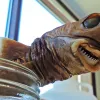
Cookie-cutter Shark
Credit: Jennifer Strotman, Collections ProgramEver heard of a cookie-cutter shark (Isistius brasiliensis)? They look like your average shark—sort of menacing and streamlined—but their name comes from how they feed. They eat smaller animals (like squid) whole, but also take large, round cookie-cutter shaped bites out of larger animals, such as tuna, whales, dolphins, and seals (which you can see in this picture of an elephant seal). They suction on to the larger animals and twist around to take a bite of flesh using their lower row of sharp teeth. No snowmen cookies though—just a round hole.

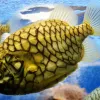
Pinecone Fish
Credit: Spencer WrightThe pinecone fish (Monocentris japonicus) looks like the real thing on land—covered in large scales with a dark trim. They are found lurking in caves and under ledges in the Indian and Western Pacific Oceans, and are a popular aquarium fish.

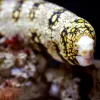
Snowflake Moray Eel
Credit: Flickr User Michael BentleyNo two snowflakes are alike. Every snowflake is beautiful in its own way. But this one’s a bit scary. The snowflake moray eel (Echidna nebulosa) has white, black and yellow splotches all over its body, which come together to look like snowflake designs. Moray eels eat their prey in a unique way – with two jaws. The second set of jaws is in their throat, which shoots up and grabs the prey from the main pair of jaws, drawing the prey down to the esophagus.

Jingle Shells
Credit: Flickr User Len BurgessThe jingle shell (Anomia simplex) is a common bivalve found on the Atlantic coast of North America, amongst the more commonly known clams and oysters. As with oysters, the lower shell is glued to a hard surface. Even after the mollusk is dead, the shell keeps its beautiful and shiny exterior. The thin, translucent shells are often used in jewelry, and when strung together can sound like bells, hence the name.

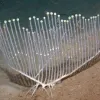
Harp Sponge
Credit: Copyright © 2005 MBARIThis newly-discovered carnivorous sponge (Chondrocladia lyra) was found using robotic submersibles operated by the Monterey Bay Aquarium Research Institute 10,000 feet below the surface in dark waters. It traps small crustacean prey with barbed hooks found along its branch-like limbs. Once it has caught something, the sponge covers it with a thin membrane and the digestion process begins.

A Chorus of Sea Angels
Credit: Copyright © Alexander SemenovThis is a tree topper unlike any other! Reminiscent of a freshly made snow angel, these pteropods are actually shell-less sea snails (Clione limacina). Unlike the typical snail, they flap their adapted foot ‘wings’ to get around in the water column. They are extremely small, with the largest species reaching only 5 centimeters long. Sea angels' mostly eat their relatives, the sea butterflies, which are threatened by ocean acidification.

Candy Cane Shrimp
Credit: Flickr User Sushi_Girl1995These candy cane snapping shrimp (Alpheus randalli) have a pretty nice set up. They share their living space with goby fish, helping the fish dig and maintain the burrow that they share in the seafloor. In turn the small, and mostly blind, shrimp (seen in this photo below the goby) get protection from predators in the form of alerts from the goby and a place to call home.