

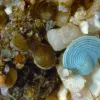
In this photo of a shallow coral reef in the Pacific there are three species of forams. On the left, Peneroplis planatus. In the center, Amphistegina lessonii. And on the right, Laevipeneroplis sp. Their colors come from the symbiotic algae that live inside the foram shells. Just like corals, these forams are subject to bleaching when ocean temperatures get high enough to kill off the colorful algae. See more images of forams and learn more about coral reef ecosystems can be found in our Coral Reefs featured story.
slideshow
Foraminifera
Microscopic, single-celled organisms called foraminifera have a fossil record that extends from today to more than 500 million years ago. Although each foram is just a single cell, they build complex shells around themselves from minerals in the seawater. These shells have accumulated in layers of sediment below the seafloor of the open ocean and in regions where the ocean once flooded the continents for millions of years. By examining the shell chemistry of these ancient forams, scientists can learn about Earth's climate long before humans ever walked the planet—and get insight into how climate changed in the past. Take a closer look at a few members of this fascinating life form.




Foraminifera
Credit: Noora Al-Meer, Flickr
Shallow Coral Reef Foraminifers
Credit: Pamela Hallock/University of South Florida
Star Sand Grains Collected from Southern Japan
Credit: Flickr User Mouser NerdBotThese star-shaped grains of sand, collected from southern Japan, look like miniature works of art -- but they were not sculpted by an artist. They are the shells of microscopic organisms called foraminifera, which build intricate shells from the calcium carbonate they collect while drifting through the water. Their shells have settled on the seafloor for 500 million years, and are used by scientists to study the earth's changing climate. Learn more about the formation of sand and the animals that call it home in the Shores and Shallows exhibit at the Smithsonian's Sant Ocean Hall, and see more pictures of foraminifera shells.

A Colorful Foram: Globigerinoides ruber
Credit: Howard J. Spero/University of California, DavisThis foraminifera was collected as it floated about 3 meters below the surface off the coast of Puerto Rico. The central dark area is the shell surrounded by spines. The tiny yellow dots are symbiotic algae, which live in the protoplasm of the host organism. When the foraminifer dies, the spines fall off and only the shell is preserved in the fossil record. Shell building animals like forams will be affected by ocean acidification and warming sea temperatures.

Globotruncana falsostuarti
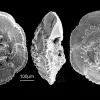
Credit: Brian T. Huber/Smithsonian InstitutionGlobotruncana falsostuarti -- a foram that lived about 75 million years ago, during the Cretaceous Period, from southeastern Tanzania. By measuring the chemistry in the shell, scientists can estimate sea surface temperatures at the time when these organisms lived and learn more about our changing climate. For this specimen, they calculate that it lived in 28°C (82°F) seawater. More about climate change can be found in our climate change featured story.


Hedbergella sliteri
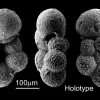
Credit: Brian T. Huber/Smithsonian InstitutionHedbergella sliteri - this specific specimen is the "holotype" for this species. That means it is the reference point for what all members of the species should look like. This specimen was identified by Smithsonian scientist Brian Huber. It was taken from a drill core near Antarctica dating back 71-66 million years ago at a time when the south polar region was much warmer, warm enough for the Antarctic continent to have forests and dinosaurs. More about climate change can be found in the Ocean Portal's climate change section.


Hantkenina mexicana
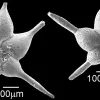
Credit: Helen G. Coxall/Cardiff UniversityHantkenina mexicana -- a foram with elongated shell chambers that lived between 45-49 million years ago, during the Eocene Epoch. This specimen is from marine sediments that were drilled in the southeast coastal region of Tanzania. Find out more about what scientists are learning about the history of Earth's climate in the Climate Change section.


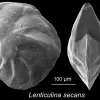
Lenticulina secans
Credit: Ines Wendler/University of BremenLenticulina secans -- this foram lives on the seafloor. This specimen was collected from ocean sediments in southeast Tanzania. It comes from a time over 92 million years ago when both the polar regions and the deep ocean were much warmer than they are today. This era is called the "Cretaceous Supergreenhouse." Scientists estimate that in this region at that time, the temperature of the ocean bottom at 600 meters was about 20°C. Present day temperatures at that depth average about 12°C. More about climate change can be found in the climate change section.
