


Corals and Coral Reefs
Introduction
Coral reefs are the most diverse of all marine ecosystems. They teem with life, with perhaps one-quarter of all ocean species depending on reefs for food and shelter. This is a remarkable statistic when you consider that reefs cover just a tiny fraction (less than one percent) of the earth’s surface and less than two percent of the ocean bottom. Because they are so diverse, coral reefs are often called the rainforests of the sea.
Coral reefs are also very important to people. The value of coral reefs has been estimated at 30 billion U.S. dollars and perhaps as much as 172 billion U.S. dollars each year, providing food, protection of shorelines, jobs based on tourism, and even medicines.
Unfortunately, people also pose the greatest threat to coral reefs. Overfishing and destructive fishing, pollution, warming, changing ocean chemistry, and invasive species are all taking a huge toll. In some places, reefs have been entirely destroyed, and in many places reefs today are a pale shadow of what they once were.
What Are Corals?
Animal, Vegetable & Mineral
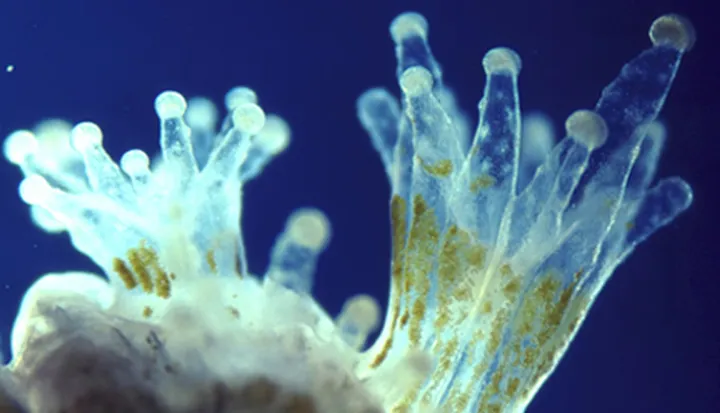
Corals are related to sea anemones, and they all share the same simple structure, the polyp. The polyp is like a tin can open at just one end: the open end has a mouth surrounded by a ring of tentacles. The tentacles have stinging cells, called nematocysts, that allow the coral polyp to capture small organisms that swim too close. Inside the body of the polyp are digestive and reproductive tissues. Corals differ from sea anemones in their production of a mineral skeleton.
Shallow water corals that live in warm water often have another source of food, the zooxanthellae (pronounced zo-o-zan-THELL-ee). These single-celled algae photosynthesize and pass some of the food they make from the sun’s energy to their hosts, and in exchange the coral animal gives nutrients to the algae. It is this relationship that allows shallow water corals to grow fast enough to build the enormous structures we call reefs. The zooxanthellae also provide much of the green, brown, and reddish colors that corals have. The less common purple, blue, and mauve colors found in some corals the coral makes itself.
Coral Diversity

In the so-called true stony corals, which compose most tropical reefs, each polyp sits in a cup made of calcium carbonate. Stony corals are the most important reef builders, but organpipe corals, precious red corals, and blue corals also have stony skeletons. There are also corals that use more flexible materials or tiny stiff rods to build their skeletons—the seafans and sea rods, the rubbery soft corals, and the black corals.
The family tree of the animals we call corals is complicated, and some groups are more closely related to each other than are others. All but the fire corals (named for their strong sting) are anthozoans, which are divided into two main groups. The hexacorals (including the true stony corals and black corals, as well as the sea anemones) have smooth tentacles, often in multiples of six, and the octocorals (soft corals, seafans, organpipe corals and blue corals) have eight tentacles, each of which has tiny branches running along the sides. All corals are in the phylum Cnidaria, the same as jellyfish.
Reproduction
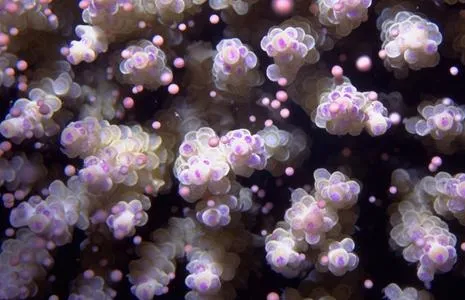
Corals have multiple reproductive strategies – they can be male or female or both, and can reproduce either asexually or sexually. Asexual reproduction is important for increasing the size of the colony, and sexual reproduction increases genetic diversity and starts new colonies that can be far from the parents.
ASEXUAL REPRODUCTION
Asexual reproduction results in polyps or colonies that are clones of each other - this can occur through either budding or fragmentation. Budding is when a coral polyp reaches a certain size and divides, producing a genetically identical new polyp. Corals do this throughout their lifetime. Sometimes a part of a colony breaks off and forms a new colony. This is called fragmentation, which can occur as a result of a disturbance such as a storm or being hit by fishing equipment.
SEXUAL REPRODUCTION
In sexual reproduction, eggs are fertilized by sperm, usually from another colony, and develop into a free-swimming larva. There are two types of sexual reproduction in corals, external and internal. Depending on the species and type of fertilization, the larvae settle on a suitable substrate and become polyps after a few days or weeks, although some can settle within a few hours!
Most stony corals are broadcast spawners and fertilization occurs outside the body (external fertilization). Colonies release huge numbers of eggs and sperm that are often glued into bundles (one bundle per polyp) that float towards the surface. Spawning often occurs just once a year and in some places is synchronized for all individuals of the same species in an area. This type of mass spawning usually occurs at night and is quite a spectacle. Some corals brood their eggs in the body of the polyp and release sperm into the water. As the sperm sink, polyps containing eggs take them in and fertilization occurs inside the body (internal fertilization). Brooders often reproduce several times a year on a lunar cycle.
From Corals to Reefs
Coral Growth

Individual coral polyps within a reef are typically very small—usually less than half an inch (or ~1.5 cm) in diameter. The largest polyps are found in mushroom corals, which can be more than 5 inches across. But because corals are colonial, the size of a colony can be much larger: big mounds can be the size of a small car, and a single branching colony can cover an entire reef.
Reefs, which are usually made up of many colonies, are much bigger still. The largest coral reef is the Great Barrier Reef, which spans 1,600 miles (2,600 km) off the east coast of Australia. It is so large that it can be seen from space!
Reefs form when corals grow in shallow water close to the shore of continents or smaller islands. The majority of coral reefs are called fringe reefs because they fringe the coastline of a nearby landmass. But when a coral reef grows around a volcanic island something interesting occurs. Over millions of years, the volcano gradually sinks, as the corals continue to grow, both upward towards the surface and out towards the open ocean. Over time, a lagoon forms between the corals and the sinking island and a barrier reef forms around the lagoon. Eventually, the volcano is completely submerged and only the ring of corals remains. This is called an atoll. Waves may eventually pile sand and coral debris on top of the growing corals in the atoll, creating a strip of land. Many of the Marshall Islands, a system of islands in the Pacific Ocean and home to the Marshallese, are atolls.
It takes a long time to grow a big coral colony or a coral reef, because each coral grows slowly. The fastest corals expand at more than 6 inches (15 cm) per year, but most grow less than an inch per year. Reefs themselves grow even more slowly because after the corals die, they break into smaller pieces and become compacted. Individual colonies can often live decades to centuries, and some deep-sea colonies have lived more than 4000 years. One way we know this is because corals lay down annual rings, just as trees do. These skeletons can tell us about what conditions were like hundreds or thousands of years ago. The Great Barrier Reef as it exists today began growing about 20,000 years ago.
Where are Reefs Found?

Corals are found across the world’s ocean, in both shallow and deep water, but reef-building corals are only found in shallow tropical and subtropical waters. This is because the algae found in their tissues need light for photosynthesis and they prefer water temperatures between 70-85°F (22-29°C).
There are also deep-sea corals that thrive in cold, dark water at depths of up to 20,000 feet (6,000 m). Both stony corals and soft corals can be found in the deep sea. Deep-sea corals do not have the same algae and do not need sunlight or warm water to survive, but they also grow very slowly. One place to find them is on underwater peaks called seamounts.
Reefs as Ecosystems
Cities of the Sea

Reefs are the big cities of the sea. They exist because the growth of corals matches or exceeds the death of corals – think of it as a race between the construction cranes (new coral skeleton) and the wrecking balls (the organisms that kill coral and chew their skeletons into sand).
When corals are babies floating in the plankton, they can be eaten by many animals. They are less tasty once they settle down and secrete a skeleton, but some fish, worms, snails and sea stars prey on adult corals. Crown-of-thorns sea stars are particularly voracious predators in many parts of the Pacific Ocean. Population explosions of these predators can result in a reef being covered with tens of thousands of these starfish, with most of the coral killed in less than a year.
Corals also have to worry about competitors. They use the same nematocysts that catch their food to sting other encroaching corals and keep them at bay. Seaweeds are a particularly dangerous competitor, as they typically grow much faster than corals and may contain nasty chemicals that injure the coral as well.
Corals do not have to only rely on themselves for their defenses because mutualisms (beneficial relationships) abound on coral reefs. The partnership between corals and their zooxanthellae is one of many examples of symbiosis, where different species live together and help each other. Some coral colonies have crabs and shrimps that live within their branches and defend their home against coral predators with their pincers. Parrotfish, in their quest to find seaweed, will often bite off chunks of coral and will later poop out the digested remains as sand. One kind of goby chews up a particularly nasty seaweed, and even benefits by becoming more poisonous itself.
Threats and Conservation
Threats to Corals
Ocean Acidification

The greatest threat to reefs is the rise in oceanic carbon dioxide levels. When carbon dioxide dissolves in seawater, the water becomes more acidic and the ocean’s pH (a measure of how acidic or basic the ocean is) drops. Even though the ocean is immense, enough carbon dioxide can have a major impact. In the past 200 years alone, ocean water has become 30 percent more acidic—faster than any known change in ocean chemistry in the last 50 million years. Calcium carbonate, the building block of a coral's skeleton, forms only if the water pH sits in a specific range. The more acidic seawater makes it more difficult for corals to build their calcium carbonate skeletons. And if acidification gets severe enough, it could even break apart the existing skeletons that already provide the structure for reefs. Scientists predict that by 2085 ocean conditions will be acidic enough for corals around the globe to begin to dissolve. For one reef in Hawaii this is already a reality.
Fishing
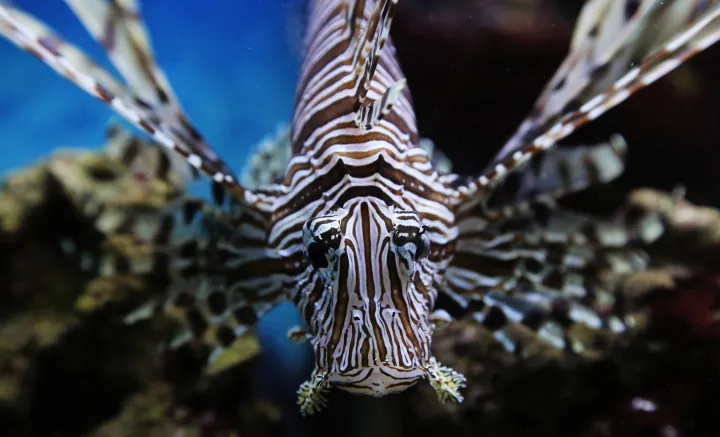
Unfortunately, warming and more acid seas are not the only threats to coral reefs. Overfishing and overharvesting of corals also disrupt reef ecosystems. If care is not taken, boat anchors and divers can scar reefs. Invasive species can also threaten coral reefs. The lionfish, native to Indo-Pacific waters, has a fast-growing population in waters of the Atlantic Ocean. With such large numbers the fish could greatly impact coral reef ecosystems through consumption of, and competition with, native coral reef animals.
Coral Bleaching

As global air temperatures rise due to the use of fossil fuels, so does the ocean. High water temperatures cause corals to lose the microscopic algae called zooxanthellae that produce the food corals need—a condition known as coral bleaching. Without their zooxanthellae, the living tissues are nearly transparent, and you can see right through to the stony skeleton, which is white, hence the name coral bleaching. Many different kinds of stressors can cause coral bleaching – water that is too cold or too hot, too much or too little light, or the dilution of seawater by lots of fresh water can all cause coral bleaching. The biggest cause of bleaching today has been rising temperatures caused by global warming. Temperatures more than 2 degrees F (or 1 degree C) above the normal seasonal maximimum can cause bleaching. Bleached corals do not die right away, but if temperatures are very hot or are too warm for a long time, corals either die from starvation or disease. In 1998, 80 percent of the corals in the Indian Ocean bleached and 20 percent died.
Bleaching events continue to be more and more frequent as the ocean warms due to climate change. Since the year 2000, mass bleaching events at the Great Barrier Reef in Australia have occurred in 2002, 2016, 2017, 2020, 2022, and 2024. And in Florida the reefs experienced the worst bleaching ever during the summer of 2023. A massive ocean heat wave caused coastal waters to reach temperatures over 100oF, a significantly hotter temperature than the 85-degree average normally experienced in July. Scientists from the Smithsonian Marine Station in Fort Pierce witnessed several species of bleaching coral off the coast of Long Key and Grassy Key. Of note, was the coral bleaching at a dive site called Coral Gardens—all the corals were bleached.
Sunscreen
Chemicals in sunscreen used to combat sunburns are now known to be harmful to corals. Even the small amount that washes off of swimmers' skin can cause a reef damage, especially in areas that are popular for swimming or diving.
Recent research studying the corals' close relatives, the anemones, suggests that corals transform certain sunscreen chemicals into potent toxins. When a coral encounters a chemical like oxybenzone it recognizes it as a foreign molecule. In an attempt to remove the chemical, corals attach a sugar to the oxybenzone, but this act actually turns it into a sun magnifier. The newly transformed chemical now amplifies the sun's UV rays and effectively bakes the symbiotic algae, causing the corals to bleach.
Several coral safe sunscreens are sold in stores, though there is still much to learn about how the active ingredients in sunscreen affect coral health.
Water Quality
Human development often causes the ocean water quality to suffer. Even activities that take place far from reefs can have an impact. Runoff from lawns, sewage, cities, and farms feeds algae that can overwhelm reefs. Toxins interfere with feeding, growing, and reproduction while excessive nutrients such as nitrogen can phosphorous can cause algal blooms that smother the corals or clouds the water. Pathogens from untreated sewage can infect corals and potentially spread into major outbreaks. Deforestation hastens soil erosion, which clouds water—smothering corals. Trash can also wash into a reef from shore, and the larger items can damage coral branches or shield them from needed sun exposure so that the zooxanthellae cannot photosynthesize.
Microplastics
As plastic continues to accumulate in the ocean, sea life will consistently come in contact with the pollution. Corals are no exception. Research indicates that corals ingest microplastics as if they were food particles. Often, plastic is covered in a film of bacteria, much like food particles that coral commonly eat. The bacteria mask the “smell” of the plastic, making it seem like prey. Most plastic pieces are expelled by 48 hours after they’ve been consumed, but some become embedded in the coral skeletons. There is also evidence that plastic pieces become embedded in coral skeletons as the corals grow around the settled plastic. Plastic that is ingested or embedded has the potential to leach toxic chemicals, which likely can harm the health of the coral.
Microplastic bacterial films not only trick corals into thinking it is food, they may also carry diseases. Plastics often come from the sea surface or land, which can host a multitude of bacteria not normally found on the seafloor. Corals already battered by ocean acidification, heat waves, and waste runoff can easily contract illness from these newly introduced bacteria.
Habitat Destruction
Corals are coastal dwellers, meaning they encounter human activity fairly frequently. Sometimes that means corals are physically damaged. Accidental ship groundings or the lowering of heavy anchors over reefs can break coral skeletons. Also, large ships require deep channels to come into ports and often that requires dredging of the seafloor to remove built up sediment. If this occurs near coral reefs, the corals can be buried in the sediments that settle away from the dredge site. One project near Miami, Florida buried over half a million corals, and though the effects were focused on the area closest to the dredging, evidence of harm was noted up to 15 miles away (25 km). Fishing gear can also damage corals, especially if misused or lost at sea. And as popular tourist destinations, reefs are highly trafficked by divers and snorkelers, many who touch or remove the corals.
Protecting and Restoring Coral Reefs
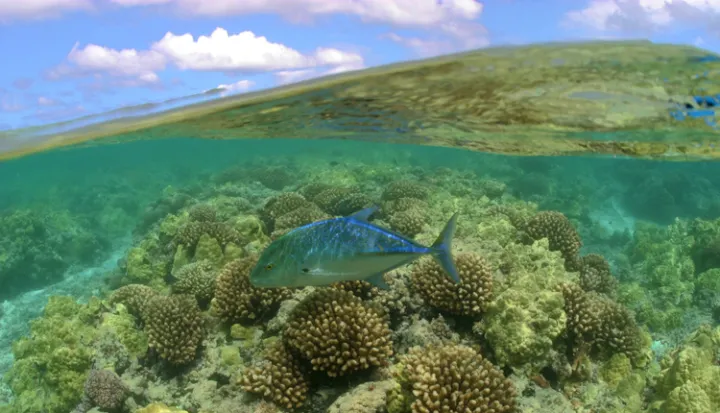
There is much that we can do locally to protect coral reefs, by making sure there is a healthy fish community and that the water surrounding the reefs is clean. Well-protected reefs today typically have much healthier coral populations, and are more resilient (better able to recover from natural disasters such as typhoons and hurricanes).
Fish play important roles on coral reefs, particularly the fish that eat seaweeds and keep them from smothering corals, which grow more slowly than the seaweeds. Fish also eat the predators of corals, such as crown of thorns starfish. Marine protected areas (MPAs) are an important tool for keeping reefs healthy. Large MPAs protect the Great Barrier Reef and the Northwestern Hawaiian Islands, for example, and in June 2012, Australia created the largest marine reserve network in the world. Smaller ones, managed by local communities, have been very successful in developing countries.
Clean water is also important. Erosion on land causes rivers to dump mud on reefs, smothering and killing corals. Seawater with too many nutrients speeds up the growth of seaweeds and increases the food for predators of corals when they are developing as larvae in the plankton. Clean water depends on careful use of the land, avoiding too many fertilizers and erosion caused by deforestation and certain construction practices. In the long run, however, the future of coral reefs will depend on reducing carbon dioxide in the atmosphere, which is increasing rapidly due to burning of fossil fuels. Carbon dioxide is both warming the ocean, resulting in coral bleaching, and changing the chemistry of the ocean, causing ocean acidification. Both making it harder for corals to build their skeletons.
Resilience
Scientists are studying how certain coral species can better withstand environmental stressors, offering hope for the future of coral reefs. In the Northwest of Australia there are coral reefs of staghorn coral (Acropora aspera) in tidal areas that experience extreme swings in temperature as the tide goes in and out. These corals experience close to a 13oF (7oC) swing daily with a maximum of 99oF (32oC). Scientists are studying this resilience to heat in the hope that it can help restore reefs in other areas. These heat tolerant corals could be transplanted to other reefs that experience more temperate and consistent temperatures and still maintain their tolerance to heat waves.
Scientists are also studying the genetic makeup of heat tolerant corals to determine the genetic source of the tolerance. Breeding these corals with other corals may provide the offspring with protection against extreme heat. Another factor is the symbiotic bacteria that live on coral. Corals with diverse and stable bacteria on their surface are more tolerant of ocean heat waves. Specific bacteria have been linked to tolerating heat and bleaching, and scientists are currently studying how to harness this protection through the use of probiotics. Applying a topical probiotic with specific, beneficial bacteria strains may help protect vulnerable coral.
Restoration
When coral reefs are destroyed by bleaching , disease, ship impacts, or oil spills there are ways that people can help restore what was lost. In the early 2000s a tactic used by aquarists to grow corals was introduced to coral reef restoration. Fragmentation is the process where small broken pieces from adult corals are individually grown into an adult coral. Rather than wait for a new coral to grow from a larva, which can take many years, this method allows for a much quicker growth of new coral in as little as 6 to 12 months. Often, the fragments are taken from reefs recently struck by storms or ships. Coral fragments are propagated from a mother coral in coral nurseries and then transplanted from the nursery into the ocean once they establish themselves. Nurseries can either be in a sheltered aquarium or in the open ocean. The open ocean nurseries string the coral fragments in tree-like structures that allow currents to circulate water around the corals. In the United States, nurseries are located in Florida, Puerto Rico, and the U.S. Virgin Islands.
Satellites
Satellites equipped with remote sensing instruments can capture high-resolution images of coral reefs from space. These images provide valuable information about the health and distribution of coral reefs over large geographic areas and can be used to map where corals are growing. Researchers use satellite imagery to identify areas of degraded or damaged coral reefs that require restoration efforts. For example, in the event of a bleaching event, satellites can help scientists determine where corals are affected. Satellites can also record temperature data to indicate when and where bleaching may occur. In the United States, the National Oceanic and Atmospheric Administration runs a program called the Coral Reef Watch that uses data from satellites to inform scientists about environmental changes in coral reefs.
Cryofreezing
Using technology developed for human sperm banks, researchers at the Smithsonian's National Zoo have pioneered methods for freezing and preserving coral sperm and stem cells. In the future, this may even apply to entire adult coral fragments. The genetic material stored in the preserved coral sperm can remain viable for centuries and the hope is that one day conservationists can use the frozen sperm to create new coral colonies and strengthen dwindling populations. Advancements in human stem cell research may eventually enable the frozen stem cells to regenerate into mature individuals.
Originating in Hawaii, this methodology has now been extended to encompass more endangered coral species globally. Notably, scientists traveled to Australia during the Great Barrier Reef's annual spawning to establish a storehouse for Australia's coral species. Their efforts in Australia have resulted in the preservation of seven crucial reef-building species. In 2013, coral specimens generated from cryopreserved sperm reached maturity, and efforts are underway to grow corals from cryopreserved embryonic cells as well.
Corals at the Smithsonian
Collections

The coral collection housed at the National Museum of Natural History may be the largest and best documented in the world. Its jewel is a collection of shallow-water corals from the U.S. South Seas Exploring Expedition of 1838-1842—one of the largest voyages of discovery in the history of Western exploration. The expedition brought back many unknown specimens that scientists used to name and describe almost all Pacific reef corals. These are known as type specimens in the collection. Altogether, the collection includes specimens of about 4,820 species of corals, and about 65 percent of those species live in deep water.
Research
Carrie Bow Cay Field Station

In the late 1960s, several Smithsonian scientists set themselves an ambitious goal: understanding the inner workings of Caribbean coral reefs. To study this complex ecosystem, they needed a field station where they could conduct research in one location, from multiple disciplines, over a long period of time.
In 1972 they came across a tiny island with three shuttered buildings. It was near all the major habitats and isolated enough to permit study of the coral reef’s natural dynamics. It was the perfect spot. More than three decades later, Carrie Bow Cay in Belize is still home to the Caribbean Coral Reef Ecosystem Program. Scientists and students from around the world continue to survey the area’s reefs, seagrass beds, and mangroves; discover new species; and pioneer new research techniques. Check out this video of Smithsonian scientists monitoring Acroporid populations near Carrie Bow.
The ARMS Project

It’s not very colorful. And it’s not made of coral. But by mimicking the nooks and crannies of real coral reefs, this Autonomous Reef Monitoring Structure (ARMS) attracts crabs, shrimps, worms, urchins, sponges, and many other kinds of marine invertebrates.
Researchers from the Census of Marine Life’s CReefs Initiative set up these temporary plastic “apartment houses” near coral reefs to learn more about the diversity of reef species. They leave the structures underwater for about a year. Then they retrieve the ARMS and analyze what life forms have taken up residence. CReefs researchers have deployed hundreds of ARMS around the world in places like Hawaii, Australia, Moorea, Taiwan, and Panama in order to compare biodiversity among different, and often distant, reefs.
Smithsonian Scientists
Dr. Nancy Knowlton

Coral reef biologist Dr. Nancy Knowlton is leading the Smithsonian’s effort to increase public understanding of the world’s ocean. She has studied the ecology and evolution of coral reefs for many years and is deeply concerned about their future. “During the three decades I’ve been studying coral reefs in the Caribbean, we’ve lost 80% of the reefs there,” she says. But she remains hopeful. “You have to make people realize that the situation is incredibly serious, but that there’s something they can do.”
Besides holding the Smithsonian’s Sant Chair for Marine Science, Dr. Knowlton currently serves on the Pew Marine Fellows Advisory Committee, the Sloan Research Fellowship in Ocean Sciences committee, and the national board the Coral Reef Alliance. She is an Aldo Leopold Leadership Fellow, winner of the Peter Benchley Prize and the Heinz Award, and author of Citizens of the Sea.
Dr. Stephen Cairns

When he was 10 years old, Stephen Cairns lived in Cuba and collected sea shells. That’s when he decided to become a marine scientist. Today he is a research zoologist at the Smithsonian’s National Museum of Natural History, focusing on the diversity, distribution, and evolution of deep-water corals—both fossil and living. Deep-water corals live up to 4 miles deep in cold, dark waters so Dr. Cairns conducts much of his field work on oceangoing research vessels and in deep-sea submersibles. Dr. Cairns has published about 150 papers and books, in which he has described more than 400 new species of deep-water corals. He assures us there are still many more to be discovered.
Dr. Andrea Quattrini

Andrea is a Research Zoologist and Curator that studies deep-sea corals. She is specifically interested in the the ecology and evolution of corals and their associated communities, and often focuses her research questions on those that live in the most poorly studied environment on earth—the deep sea. Andrea strives to work on projects that directly connect with global issues in order to help effectively conserve vulnerable marine ecosystems in the face of global ocean change. Andrea has sailed on numerous research vessels throughout the North Atlantic Ocean using submersibles and ROVS and is passionate about teaching the public about her work.
Dr. Joan Murrell Owens

Dr. Owens began her time at the Smithsonian when she was a geology student at George Washington University. Owens took on a museum technician position at the National Museum of Natural History to earn money while in school, and later, once she became a professor at Howard University, she used her ties to the museum to continue research using the museum's collections. Fascinated by the marine world, Owen's was unable to dive due to sickle-cell anemia, a hereditary condition that limits the amount of oxygen carried by blood cells. Undeterred, she based her research on collections housed in the museum. Using the Smithsonian's Albatross collection from 1880, Owens discovered a new genus of deep sea button corals called Rhombopsammia. She eventually discovered three species from this genus, including one she named after her husband.