


Gulf Oil Spill
Introduction
The Deepwater Horizon oil spill is recognized as the worst oil spill in U.S. history. Within days of the April 20, 2010 explosion and sinking of the Deepwater Horizon oil rig in the Gulf of Mexico that killed 11 people, underwater cameras revealed the damaged wellhead pipe was leaking oil and gas on the ocean floor about 42 miles off the coast of Louisiana. By the time the well was capped on July 15, 2010 (87 days later), an estimated 3.19 million barrels of oil had leaked into the Gulf.
The well was located over 5,000 feet beneath the water’s surface in the vast frontier of the deep sea—a permanently dark environment, marked by constantly cold temperatures just above freezing and extremely high pressures. Scientists divide the ocean into at least three zones, and the deep ocean accounts for about three-quarters of Earth’s total ocean volume.
Immediately after the explosion, workers from BP and Transocean (the rig operators), and many government agencies tried to control the spread of the oil to beaches and other coastal ecosystems using floating booms to contain surface oil and chemical oil dispersants to break it down underwater. Additionally, numerous scientists and researchers descended upon the Gulf region to gather data. Researchers are still trying to understand the spill and its impact on marine life, the Gulf coast, and human communities.
You can explore the spill in our interactive and read on for more information.
The Spill
The Oil's Spread

Over the course of 87 days, the damaged Macondo wellhead, a part of the Deepwater Horizon oil rig, located around 5,000 feet beneath the ocean's surface, leaked an estimated 3.19 million barrels (over 130 million gallons) of oil into the Gulf of Mexico—making the spill the largest accidental ocean spill in history.
Once the oil left the wellhead, it spread throughout the water column. Some floated to the ocean's surface to form oil slicks, which can spread more quickly by being pushed by winds. Some hovered suspended in the midwater after rising from the wellhead like a chimney and forming several layers of oil, dispersant and seawater mixtures drifting down current; during the spill a 22-mile long oil plume was reported. This plume formed because chemical dispersants, released into the water to break up the oil so it could wash away, allowed the oil to mix with seawater and stay suspended below the surface. It turned out adding dispersant had an unforeseen consequence—it increased the area that the oil traveled by 49 percent, increasing the area impacted by the spill.
Not all the oil made its way to the surface, however. Some oil sunk to the seafloor by gluing together falling particles in the water such as bacteria and phytoplankton to form marine snow. As much as 20 percent of the spilled oil may have ended up on top of and in the seafloor, damaging deep sea corals and potentially damaging other ecosystems that are unseen from the surface.
Cleanup Methods
Physical Methods
When oil spills into the ocean, it is difficult to clean up. When you have 3.19 million barrels to clean up, it is even harder.
Part of the difficulty is that no two spills are alike. The amount and type of oil (whether crude or refined) affects how it spreads, and a spill in seawater spreads differently than in freshwater. Local environmental conditions also play a huge role: currents, tides, weather, wind speed and direction, air temperature, water temperature, and presence of ice all affect how the oil spreads and how well cleanup workers can access the spill area. This variability makes it difficult to plan for spills ahead of time.
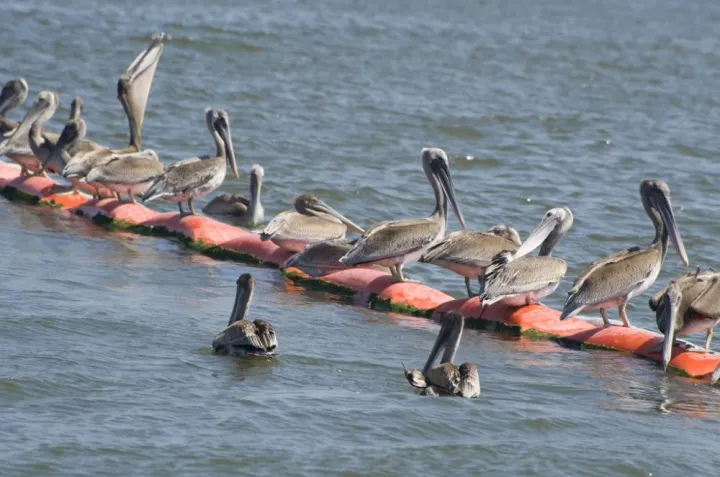
The most basic method of cleanup is to control the spread of the oil using physical barriers. When oil spills in water, it tends to float to the surface and spread out, forming a thin slick just a few millimeters thick. (A very thin slick is called a sheen, which often looks like a rainbow and can be seen in parking lots after a rainstorm.) Cleanup workers first surround the slick with floating booms to keep it from spreading to harbors, beaches, or biologically important areas like marshes. Then they can use different tools to remove the collected oil. Often they will drive skimmers, boats that skim spilled oil from the water's surface, through the slick. Only about 2-4 percent of the oil was recovered by using skimming.
After as much oil as possible is removed by skimmers, workers use sorbents to mop up the trace amounts left behind. Sorbents either absorb oil like a sponge or adsorb oil, which means that oil sticks to its surface. They come in three main types: natural organic materials like peat moss, straw, hay, and sawdust; natural inorganic materials like clay, volcanic ash, sand, or vermiculite; and synthetic sorbents made of materials similar to plastic like polyurethane, polypropylene, and polyethylene. Which type is used will depend on the particular spill, as some types of sorbents work best on different types of oil and under different weather conditions.
Another option is to burn the oil away. Oil is composed of flammable molecules, so one way to rid them from the ocean is to start a controlled burn at the ocean’s surface. About 5 to 6 percent of the oil from the Deepwater Horizon oil spill was removed by controlled burning.
Dispersants
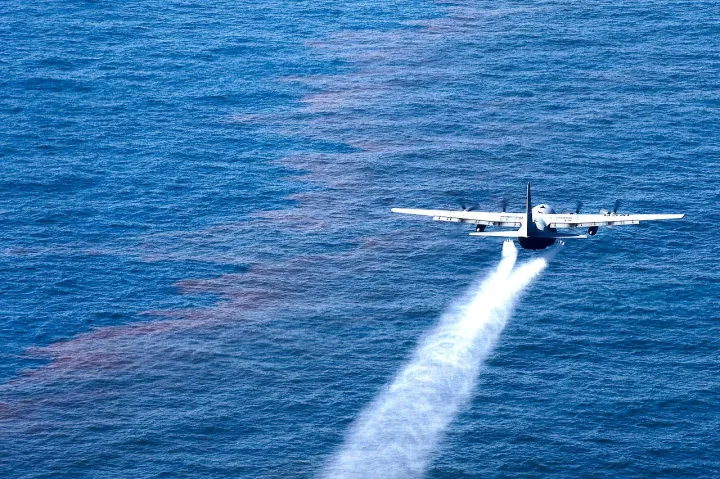
Removing spilled oil from the environment is a difficult task. Because oil is hydrophobic (doesn't mix with water), it floats to the surface when it spills into the ocean and forms large slicks. These slicks can wreak havoc on coastal ecosystems and animals, so cleanup workers use dispersants—chemicals that break down the oil into smaller particles that mix with water more easily—to prevent them from forming. Evaporation, sunlight, and bacteria can then degrade these tiny droplets more quickly than if they were in a large slick, or waves can wash them away from the spill site.
Dispersants are often used when workers want to stop the slick from spreading to a protected area like a harbor or marsh. This can be a boon for animals found on the surface and coast, such as seabirds, marine mammals, and those found in the Gulf’s mangroves, because the oil is moved out of their habitat. But dispersants can also enter the food chain and potentially harm wildlife.
In the case of the Deepwater Horizon oil spill, clean-up workers treated the oil with over 1.4 million gallons of various chemical dispersants. Typically such large amounts are sprayed over the open ocean from an airplane or helicopter. But during the Deepwater Horizon oil spill, they were also injected straight into the Macondo wellhead, the source of the leak, in order to reduce the amount of oil that reached the ocean surface. Five years after the spill, some scientists believe that injecting dispersants directly at the wellhead may not have done much to help reduce the size of the oil droplets.
Just because the oil and dispersants are out of human sight and mind in the deep sea doesn't mean they're gone. It's possible that life in the deep sea was exposed to the dispersant-oil mixture. Scientists have found that the dispersant-oil mixture was rapidly colonized and broken down by bacteria that sunk towards the bottom. Any bits of the mixture that didn't get broken down would then get buried in coastal and deep-sea sediments, where its breakdown slowed.
While the dispersant helps expose more of the oil to bacteria and waves which help to break it down, it also makes the oil more available to wildlife. One 2012 study showed that the combination of oil and the dispersant Corexit is 3 to 52-times more toxic to rotifers (microscopic animals) than oil by itself. This isn't because of anything inherently dangerous in the mixture of the two; the rotifers are more able to ingest oil once it's made accessible by the dispersant. But overall, scientists have concluded that the amount of combined oil and dispersant determines if it is toxic or not, and the concentrations during the Deepwater Horizon oil spill were below those levels that would be more toxic to marine species than the oil alone. Oil slicks in and of themselves are toxic to marine wildlife, and this must be taken into consideration when choosing to use dispersants.
There is still more research needed to understand the effects of dispersant. A modeling effort supported by the Gulf of Mexico Research Initiative offered evidence that the dispersants injected into the Macondo wellhead may not have helped to lessen the amount of oil reaching the surface after all.
A lot of research is still needed to fully understand the long-term effects of dispersants and oil on the region and its inhabitants—not to mention how they move through the food chain to impact larger predators, such as people. Researchers are developing new dispersants that cause less environmental damage for the next spill. (See "Human Health Impacts.")
Ecosystem Effects
Effects on Wildlife
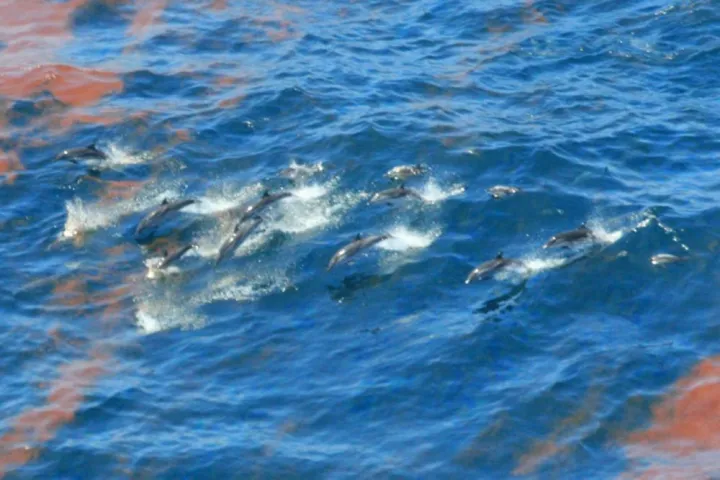
There were some immediate impacts to the animals of the Gulf of Mexico that could be seen with the naked eye: pelicans black with oil, fish belly-up in brown sludge, smothered turtles washed up on beaches. But many of the long-term effects from the spill cannot be seen with the naked eye. Many exposed animals initially weathered the spill but then were marred with health problems for years afterward.
Strandings of both dolphins and sea turtles increased significantly in the years following the spill. From the time of the spill in 2010 to 2014, over a thousand dolphins were found stranded along the shores of the Gulf. Many of the dolphins suffered from lung disease, increased stress, and a compromised immune system. Those that did not survive became part of the largest and longest dolphin die-off in the recoded history of the Northern Gulf of Mexico. Since then, dolphin deaths have declined, but dolphins in hard-hit Barataria Bay continue to have issues giving birth to healthy babies. Only 20 percent of pregnant mothers successfully carry their babies to full term, while in other areas the rate is around 80 percent. Many also continue to suffer from lung disease, and in many cases their lung health is worse than at the time of the spill.
Monitoring of sea turtles both during and after the spill was difficult, though an understanding of general sea turtle behavior allowed scientists to estimate that up to 167,600 turtles died because of the spill. The number of Kemp's ridley sea turtle nests have gone down in the years since the spill, and long-term effects are not yet known.
Seabirds were initially harmed by crude surface oil—even a small bit of oil on their feathers impeded their ability to fly, swim and find food by diving. Those that ingested the oil experienced severe health issues including anemia, weight loss, hypothermia, heart and liver abnormalities, delayed egg laying, decreased eggshell thickness, gastrointestinal dysfunction, and death. Some birds were even disturbed during cleanups, their eggs crushed by workers’ boots. Ninety-three species of birds were affected by the spill, and it is estimated that 800,000 coastal and 200,000 offshore birds died.
Invertebrates in the Gulf were hit hard by the Deepwater Horizon spill—both in coastal areas and in the deep ocean. Shrimp fisheries were closed for much of the year following the spill, but these commercially-important species now seem to have recovered. Deep-water corals grow very slowly and can live for many centuries. Found as deep as 4,000 feet below the surface, corals near the blowout showed signs of tissue damage and were covered by an unknown brown substance, later identified as oil from the spill. Laboratory studies conducted with coral species showed that coral larvae exposed to oil and dispersant had lower survival rates and difficulty settling on a hard surface to grow.
The impact of the spill on fish populations is still largely unknown, though the study of specific fish species indicates that there could be long-lasting effects for fish exposed to oil. Initially, fishermen reported an uptick in fish with skin lesions. But scientists also know that there are likely chronic health defects associated with oil exposure. Lab studies have shown that oil can cause heart defects in both developing larvae and adult fish. A significant study of adult mahi-mahi showed that even 24 hours of oil exposure leads to changes in their heart. A mahi-mahi’s heart loses its ability to efficiently pump blood throughout the body, likely because their heart muscle cells begin to contract less. Researchers are producing a system that assesses the vulnerability of various fish species to oil exposure, which will provide important information to those responding to oil spills.
Microbes, however, were one of the few groups of species to actually benefit from the spill. While a lot of bacteria are impacted by oil toxicity like most every other living species, a select group of bacteria are oil lovers. Life in the Gulf of Mexico has exposed them to small traces of oil from natural seeps and they have evolved to take advantage of this novel resource. After the spill they grew slowly at first, but once they reached their peak in early June, the microbes were consuming methane at among the fastest rates ever reported for the open ocean—some 60,000-times faster than methanotrophs living at a methane seep. While oil-loving bacteria are usually scarce, after the oil spill they accounted for about 90 percent of the microbes in contaminated water. This had a ripple effect in the community as smaller animals ate the bacteria. Some fish larvae populations actually grew after the spill, as they had more food in the form of oil-eating microbes.
Over 1,000 miles of shoreline on the Gulf of Mexico, from Texas to Florida, was impacted by oil from the Deepwater Horizon blowout. Much of this area has been cleaned, but eroded shorelines are taking longer to recover and erosion rates have accelerated in these areas.
Where Did the Oil Go?
Tracking the Spill
When the wellhead ruptured, oil quickly leaked into the surrounding water, about 5,000 feet beneath the sea surface. At the wellhead, 16 to 17 percent of the oil was recovered during cleanup efforts and piped onto nearby ships for storage and removal. The remaining oil was pumped with chemical dispersant and began to rise. Like the salad dressing in a shaken bottle, the oil began to float toward the sea surface, as oil is less dense than water.
Yet on its way upward, a little less than half of the oil was halted at about 3,600 feet (1,097 meters) below the surface where it then formed a suspended plume. Scientists are unsure why this happened but believe the hot oil influenced ocean currents, which then trapped the oil deep underwater. Mixed with dispersant, the oil formed many tiny droplets and became neutrally buoyant—the same density as the surrounding water. The suspended plume then encountered a southern flowing current which pushed the oil into the continental slope, the seafloor that rises from the ocean depths up to the seashore. There, it collected in the seafloor sediments.
The other half eventually rose to the surface. About a quarter of this oil soon evaporated into the air and about 10 percent was cleaned using booms or burning. The remainder became trapped by a swirling eddy, which luckily contained the oil spill to one concentrated area. Winds and currents pushed the oil mass to the west where it eventually found its way into coastal Louisiana. When the oil washed up on shore it came in the form of tarballs, slicks, and what responders call “mousse”—a foam-like combination of water, oil, and air.
As the majority of the oil made its way up toward the surface, some oil got left behind. Oil, dispersant, microbes, and mucus clumped together to form increased amounts of marine snow, dense particles which fall down to the seafloor from above. It turns out that the oil and gas actually helped form marine snow and caused it to sink at a very high rate, in what researchers called a "dirty blizzard" event. This brought oil with it to the seafloor, and to the deep-sea communities that rely on nutrients in the form of certain chemical compounds (like methane, often found in crude oil) typically making its way to them from surface waters or bubbling up from hydrothermal vents below the seafloor.
There are several estimates of how much, and where, oil ended up on the seafloor—researchers generally agree between 3 and 10 percent of the oil released found its way to the bottom of the ocean.
Modeling the Movement
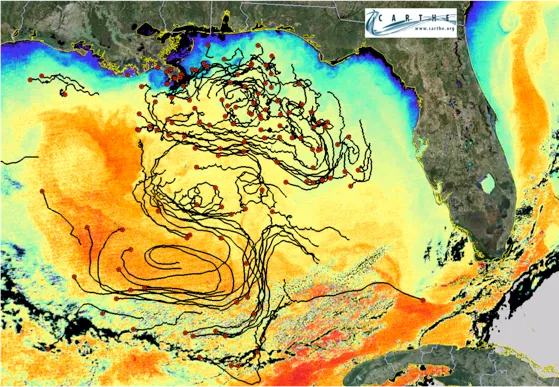
Once the over 200 million gallons of oil began spewing out of the damaged wellhead—where did it go? Keeping track of that much oil—especially as it sinks into the deep sea—is a difficult task that can't be done with eyes alone. Along with visual tracking, submersibles and computer models of the oil's movement helped researchers get a better sense of what path it took and where it ended up.
In May 2010, the Monterey Bay Aquarium Research Institute (MBARI) sent a high-tech robotic submersible to the oily waters of the Gulf of Mexico. Like other autonomous underwater vehicles (AUV), the robotic sub was programmed at the surface to navigate through the water on its own, collecting information on deep oil plumes from the Deepwater Horizon spill as it traveled. Although satellites and aircraft helped show the extent of the spill at the surface, researchers hoped that the AUV would allow them to understand what was happening farther down in the water column. During the NOAA-sponsored expedition, MBARI's AUV mapped part of the plume at 1,000 meters (3,300 feet) below the surface and collected water samples at various depths. The resulting data helped the researchers identify a persistent deep oil plume and link the oil in this plume to its source: the Deepwater Horizon blowout.
To build models of oil movement at the surface, researchers first had to understand where ocean eddies, currents and waves carried the tiny oil particles. To understand surface water movement better, researchers set small, yellow boards made of wood afloat on the ocean's surface and asked beachgoers to report where they found these “drift cards” when they washed up onshore. This citizen science endeavor provided general information about how far the waves can carry a floating object and specific data points that can be used to improve models of where the oil disperses.
Further data collection has been ongoing since the spill by the Consortium for Advanced Research on Transport of Hydrocarbon in the Environment (CARTHE). CARTHE has more high-tech "drift cards:" their “drifters” are small buoy-like instruments with GPS, which ping their locations to satellites as they drift on ocean currents. Their location gets tracked for weeks or months at a time and provide an unprecedented amount of location-based data for modeling. This information can be used to better predict oil movement in case of future spills, as well as predict other current-related movements like for marine debris and algal blooms.
Absorbed into the Ecosystem

After the Deepwater Horizon spill, oil was mixed throughout the ocean and made its way to coastal and deep-sea sediments. Researchers continue to collect samples from both the water and the sediment to determine if oil is present, and where exactly it came from. Chemical analysis of oil found after a spill can be used to determine its original source. In the case of Deepwater Horizon, tracking the origins of oil slicks that appeared after the well was capped proved helpful in determining if a new leak might have sprung.
Gulf of Mexico Research Initiative
Research Projects

About a month after the Deepwater Horizon oil spill (while the oil was still leaking out of the Macondo wellhead) BP announced that they would provide $500 million to fund an independent research program that would study the impacts of the spill on the environment and public health. With this funding, the Gulf of Mexico Research Initiative (GoMRI) was formed as a 10-year independent research program. The GoMRI Research Board makes funding and research decisions, and as of 2020 over $425 million has been distributed to research institutions, many of which are located in Gulf states.
At the outset, the twenty-person GoMRI Research Board adopted five main research themes to focus on: physical movement of the oil and dispersant, degradation of the oil and its interaction with the ecosystem, environmental effects of the oil and dispersant, development of technology for improved response and remediation, and the effects of oil and dispersant on human health. GoMRI-funded studies have examined where the oil went after the spill and how the oil affected many types of marine life, including deep-sea coral ecosystems, seabirds, and jellyfish, to name just a few.
Read more about GoMRI research:
- CARTHE Drifters: Where does oil go when it is spilled?
- Breaking Down the Myths and Misconceptions About the Gulf Oil Spill
- Little Critters that tell a BIG Story: Benthic Foraminifera and the Gulf Oil Spill
- Anatomy of An Oil Spill: Gulf of Mexico Oil Spill Interactive
- How Oil Feeds the Deep Sea
- Oil Invades Coral Communities of the Deep (Slideshow)
- Beyond the Sea: How Oil Spills in the Ocean Affect Birds On Land
- How Methane Fueled a Food Web after the Gulf Oil Spill
- Building a Better Dispersant
- After the Oil Spill: Research Projects in the Gulf of Mexico with GoMRI
- How An Oil Spill Affects the Movement of Carbon In the Ocean
- Tracking Dead Zones In the Gulf
- Searching For Links Between Deepwater Horizon & Human Health
- Five Things The Gulf Oil Spill Has Taught Us About the Ocean
- How Jellyfish Break Down Oil After a Spill
- Three Ways You Can Use Genomics to Study Oil Spill Impacts
- Do You Have The Answer? Sharing Big Data in the Gulf of Mexico
- 15 Creatures in the Gulf of Mexico that are Stranger Than Fiction
- Meet the Tiny Bacteria That Give Anglerfishes Their Spooky Glow
- From Larvae to Adults – Finding Impacts of an Oil Spill on Mahi Mahi
- A Brittle Star May Be a Coral’s Best Friend
- Fish Get Risky Around Oil
- Seeing with Sound: Acoustic monitoring of beaked whales can help determine oil spill impacts
- The Gulf of Mexico: A Deep-Sea Treasure Trove of Fishes
- Fish Heart Out of Water
- Where Did the Oil Go In the Gulf of Mexico
- How to Survive an Oil Spill: Oyster Edition
- Five Methods for Tracking the Ocean's Motion
- What the Big Picture Can Teach Us About Tiny Ocean Creatures
- The Bone that Logs a Lifetime
- What are Fossil Fuels? (Interactive)
- A Bacterium's Super Powers
- Protecting the Most Vulnerable Fish After an Oil Spill
- The Musical Hearts of Dolphins
- Discoveries Abound During Oil Spill Research
- Oil's Legacy in the Open Sea
- Research Discoveries From the Deepwater Horizon Gulf Oil Spill (video)
- Gulf of Mexico Oil Spill Milestones - A Deepwater Horizon Timeline
Research
Collections
Smithsonian holdings may show oil's impact in Gulf

As scientists in the Gulf collect organisms potentially affected by the oil, they will need to compare them to animals from previous decades to identify how they have changed, if at all.
Here's where Smithsonian Collections can play a role. Soon after the Deepwater Horizon oil spill, Smithsonian Collections staff plotted invertebrate holdings from the Gulf onto Google Earth. Since 1979, invertebrate specimens have been deposited in the national collections of the National Museum of Natural History's Department of Invertebrate Zoology. In the Gulf of Mexico, more than 57,000 invertebrates (points on the map) from 5,789 distinct collecting sites from 14 Mineral Management Service survey programs (point colors) have been cataloged.
Following the Deepwater Horizon incident in late April 2010, collections staff updated the files to reflect the latest areas affected by the spill in real-time. “The points on the map represent less than half of our Gulf of Mexico holdings, the rest—approximately 75,000—still need to be processed and cataloged,” said Bill Moser, museum specialist.
Oil Spill Lessons from Panama

A Smithsonian study of a 1986 oil spill on the coast of Panama attracted renewed interest for its insights into the effects of oil spills on coastal systems. Working with the Smithsonian Tropical Research Institute, marine ecologist Dr. Jeremy Jackson and a team of researchers examined the spill’s immediate and long-term effects on the coast in Bahia las Minas, Panama.
The benchmark study (PDF), published in 1989, documented the damage oil causes to coastal and tidal habitats. It's particularly notable because it includes 15 years of ecological data about the area before the spill collected by the Smithsonian. The affected area includes the Smithsonian biological reserve known as the Galeta Marine Laboratory. “What we learned, in a nutshell, was never, ever, ever, ever allow oil to get into a complex coastal system of mangroves, sea grasses, and coral reefs because you’ll never get it out,” said Dr. Jackson.
In this video interview with the Smithsonian Ocean Portal, he reflects on the Panama study and its implications for the Deepwater Horizon oil spill and reminds listeners that the greatest threats to the ocean—overfishing, climate change, and other types of pollution—combined actually exceed the devastation that unfolded in the Gulf of Mexico oil spill. “If there’s any silver lining in the [Gulf] oil spill,” he said, “it’s that it might make us wake up to the magnitude of what we’re dealing with.”
Featured Scientist
Dr. Chris Reddy, Marine Chemist

At Woods Hole Oceanographic Institution in Massachusetts, Chris Reddy studies the long-term effects of oil spills, as well as natural oil seeps that occur off the coast of Santa Barbara, California. In this video, watch as he digs beneath the surface in Wild Harbor salt marsh in Cape Cod, Massachusetts to find layers of oil from a spill that occurred more than 40 years ago. This leftover oil continues to impact the wetland's ecology and wildlife. “When this spill first occurred in 1969, about a month after I was born, people thought that it would only last a week,” he says. And to the naked eye, the marsh looks beautiful and pristine. But oil has persisted in the sediments and continues to adversely affect the marsh’s mussels, crabs, and grasses. “Oil can last for a long time and has a lot of biological impact.” In June 2010, Dr. Reddy testified before a Congressional panel investigating the Gulf oil spill.
Threats & Solutions
Human Health Risks

In the immediate aftermath of the Deepwater Horizon oil spill, concerns about public health focused on people coming into direct contact with the oil and dispersants. The Centers for Disease Control and Prevention offered safety advice to Gulf Coast residents and relief workers, and the EPA conducted toxicity tests on dispersants. A recent study discovered dispersants had an unintended benefit during the initial oil cleanup. As the dispersant broke apart the oil into smaller droplets it also decreased the amount of harmful gases that rose to the sea surface where emergency cleanup crews were working. This decreased the health risks associated with working near the spill, reduced the number of days where it was too hazardous to work, and enabled a quicker cleanup. However, long-term questions about oil spills and their impact on human health remain. The National Institutes of Health began to address these in a study that is tracking 33,000 cleanup workers and volunteers for a decade. The research will assess whether exposure to crude oil and dispersants has an effect on physical and mental health.
As the days, weeks, and months progressed the indirect impacts related to seafood consumption also gained attention. The chemicals in oil that are of most concern to humans are called polycyclic aromatic hydrocarbons (PAHs). Some of these are known to cause cancer. The U.S. Food and Drug Administration is charged with monitoring the levels of PAHs in Gulf Coast seafood. It works in conjunction with NOAA, the EPA, and state agencies to determine which fisheries are safe to open and which ones should be closed. In order for a fishery to be reopened, it must pass both a "smell" test and a chemical analysis. Seafood cannot go to market if it contains harmful levels of PAHs or if it emits an odor associated with petroleum or dispersants. Fishing area closures peaked on June 2, 2010, when 88,522 square miles of the Gulf of Mexico were off-limits. On April 19, 2011, NOAA announced that commercial and recreational fishing could resume in all of the federal waters that were affected by the spill.
Nine years after the spill, the National Academy of Science determined that dispersant impacts on seafood were extremely low, citing studies that found dispersant chemical concentrations to be low or nonexistent in fish and shellfish.
Rescuing Animals in the Oil Spill

Pictures of pelicans, sea turtles, and other Gulf of Mexico wildlife struggling in oil were among some of the most disturbing images of the Deepwater Horizon oil spill disaster in 2010. According to the U.S. Fish and Wildlife Service, thousands of “visibly” oiled animals (pdf) —which include birds, sea turtles, and marine mammals—were collected by authorities in the vicinity of the Deepwater Horizon oil spill. Many of the animals were already dead, but for those found alive, dozens of organizations, including the Smithsonian’s National Zoological Park and the New England Aquarium (NEA), were mobilized to rescue, rehabilitate, and later release animals affected by the spill. National Zoo personnel were dispatched to the Gulf largely to assist with the process of relocating animals affected by the spill and helping to identify future release sites for those rescued. Dr. Luis Padilla, a Zoo veterinarian who helped with a pelican release in Texas, and Dr. Judilee Marrow were among those who assisted in the Gulf.
NEA staff who helped to rehabilitate sea turtles rescued from the Deepwater Horizon oil spill offered a behind-the-scenes view on the aquarium’s Marine Animal Rescue Team Blog. The blog described how rescuers in boats and spotter planes were “looking for rounded mounds on the surface of the oil, which usually means that there is a turtle floating under the surface of the oil." The rescue team, based at the Audubon Aquarium of the Americas in New Orleans, treated dozens of endangered sea turtles, such as Kemp's ridley, loggerheads, green sea turtles, and hawksbills. To learn more about how oil affects marine life, watch this video from the Pew Environment Group that explains the impact of oil on marine life throughout the water column and check out this fact sheet from U.S. Fish and Wildlife which summarizes “Effects of Oil on Wildlife and Habitat.” (pdf) We may not know the full effects of the spill on animals - both big and small - for years to come. (See "Ecosystem Effects.")
The Case for the Gulf

In testimony before a committee of the U.S. House of Representatives, Dr. Sylvia Earle, National Geographic Explorer-in-Residence and former chief scientist of NOAA, offered specific suggestions for addressing the catastrophic oil spill in the Gulf and delivered an impassioned call for greater investment in ocean research—including more expeditions to explore the Gulf’s deep waters, establishing permanent monitoring stations and protocols, and encouraging tri-national collaboration among scientists and institutions around the Gulf. “No one has descended to the greatest depth in the Gulf of Mexico, about three miles down in the Sigsbee Deep near Yucatan. In fact, no one knows for sure exactly where the deepest place in the Gulf is, or if they do, proving it has been an elusive goal,” she said.
Restoration Over Multiple Decades

Due to the scale of the Deepwater Horizon oil spill, the entire ecosystem of the Gulf of Mexico was affected which required unprecedented restoration efforts. As early as 2011, restoration work began in the Gulf before the extent of the damage from the spill was fully assessed. These early restoration efforts included replanting dune vegetation that had been trampled during cleaning efforts and wetland restoration to replace marshes exposed to oil that washed ashore. Initially, 65 projects were approved and funded in the early phases of restoration. In 2016, BP reached an historic settlement which included 8.8 billion dollars for restoration. This was essential to funding the majority of the Gulf’s restoration work. A series of restoration plans have been released since, and by January 2024, there were over 320 restoration projects.
These restoration projects span a large range of activities and are all different in size, type, and timeline. Some projects involve restoring entire habitats. Since the 1930s, Louisiana’s Barataria Basin has lost over 276,000 acres (431 square miles) of important salt marsh habitat to sea level rise and erosion. Salt marsh exposure to oil speeds up that erosion process. So to help combat this, 1,200 new acres (2 square miles) of salt marsh habitat are being created through Louisiana’s Upper Barataria Marsh creation project. This is one of the largest marsh restoration projects NOAA has ever undertaken. To create the new habitat, 8.4 million cubic yards of sediment (enough mud to fill 2 superdomes) had to be pumped 13 miles from the Mississippi River to the restoration site.
Other restoration projects funded by the oil spill are focused on helping restore the populations of individual species. The common loon, which winters in the Gulf of Mexico, was one of the birds most affected by the spill. To help restore loon populations, projects far from the Gulf of Mexico are underway in Minnesota where the common loon breeds. Workers are building artificial nesting platforms to help boost nesting success and there are plans to preserve loon breeding grounds.

Final payments supporting restoration projects from the settlement are scheduled for 2031, but for the Gulf of Mexico ecosystem, recovery may still be decades away. Some species injured by the oil spill are long-lived, which means they will be slow to bounce back. One habitat that will be particularly slow is deep coral and sponge habitats on the seafloor of the Gulf of Mexico. The corals and sponges that make up this habitat can live for hundreds, even thousands, of years and some grow less than a millimeter a year. Corals that lost branches or died following the spill may take decades to regrow. Several restoration projects are funded to help boost recovery for these habitats. These projects are learning more about these understudied habitats and species to most effectively restore and protect them. One of the restoration efforts involves developing new methods to encourage coral growth at these depths including propagating existing corals and placing different materials on the seafloor to learn which best support new coral and sponge growth. The road to recovery is long, but the work of these restoration projects may help speed the process along.